Lella Crowder, to me Zia Lella, was my mother’s younger sister who moved to the UK from Sicily at the age of 18. She married an Englishman, Uncle Alan, and they had two children, Paul and Francesca. Zia Lella passed away May 30th, 2014. All through my life she was a great presence and a source of love and joy.
Over the last few years, it had become a tradition, as I traveled to Sicily from the USA, to stop in England and visit Zia Lella and her family. Having been diagnosed with Alzheimer’s fourteen years ago, over the years, Zia Lella’s quality of life had declined tremendously. However, when I visited her, it gave me great joy to be with her, hold her hand, and know in my heart that she knew I was a special person in her life.
This year, I was planning to visit for a few days, in May, on my way to Sicily. However, Zia Lella’s condition worsened shortly before my arrival and upon arrival I knew I would not leave for a while. I had the privilege of being at her side, together with her children, Francesca and Paul, during her final weeks and the memory of those days will live with me forever.
Farewell My Zia Lella
When I was born you enveloped me with your LOVE and that LOVE grew throughout our lives! However, I was not the only one touched by your Smile, Laughter and LOVE.
Then one day, that awful disease crept up slowly taking you away, but inside of you YOUR spark endured and still escaped to greet those whom you loved when they came to you.
Now, you have gone to the Home of the Father. May you dance again with Alan, Charlie and Ray; hold hands with Nuccio and Giovanna, embrace Gregorio, Tina, Mamma e Papa’.
At last, for those of us who remain on this Earth, may the LOVE you spread nestle in our Hearts to comfort us until we meet again!
Zia Lella and I at my home in Germany years ago……….

This post is not on Sicily.
As I will be heading back to Sicily in May, I have come to visit my daughter, Julia, who is currently a student at the Graduate School of Business at Stanford University, Palo Alto, California.
I have spent precious time with Julia and Chris, met and enjoyed the company of their friends, visited San Francisco, hiked around Palo Alto, enjoyed long walks around campus and eaten some wonderful food!!!!
Driving from SF airport to Palo Alto, of course, I ran into the Google map car!!! I had actually met my last one in Ragusa Ibla, Sicily, two years ago.

On campus, the Hoover Tower was a landmark for finding my way around.

A view from the Hoover Tower Observation Platform

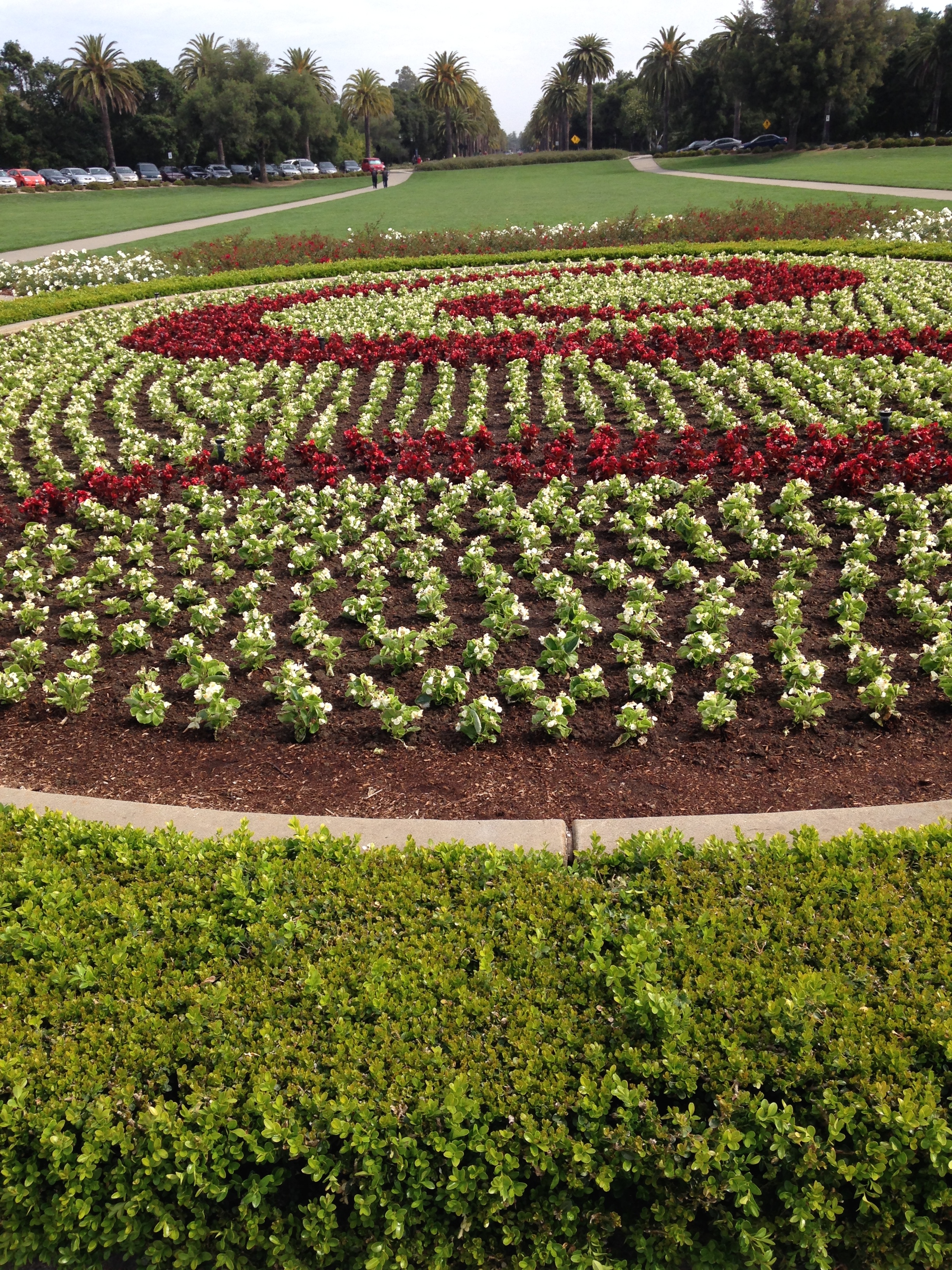
Beautiful begonia garden at entrance to Palm Dr. which I walked many times

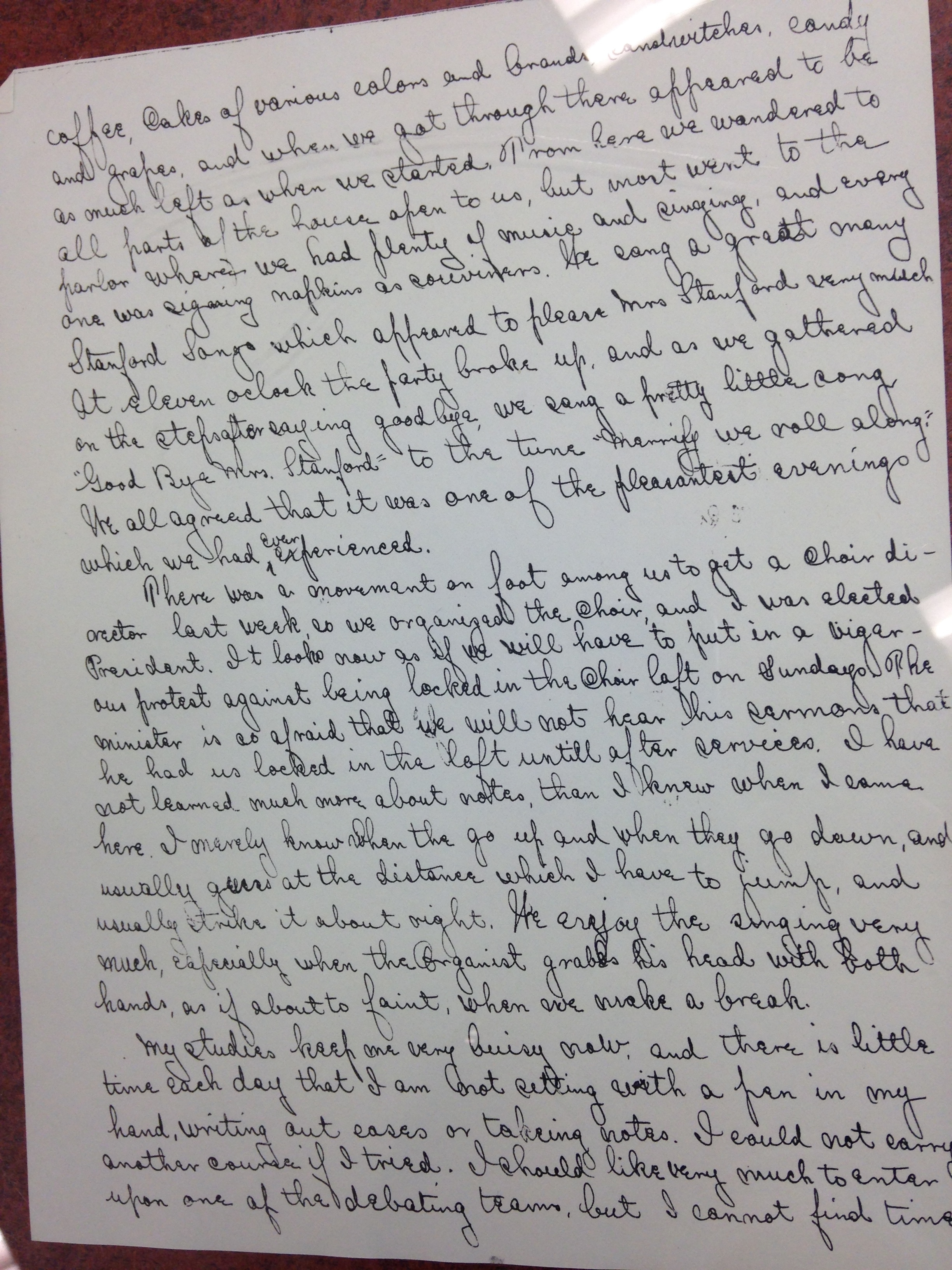
Parts of a letter written in 1904 by a Stanford student telling about his visit to Mrs. Stanford’s home. This letter and others can be found on display at one of the cafe’s on campus.

Julia’s residence building

My last night, Julia, Chris and I joined an Italian friend, Michele, and his lovely parents for dinner. The Italian restaurant,Terùn, located in Palo Alto, is owned by Maico. Maico is a true example of excellent entrepreneurship as he came to the USA only five years ago and, at that time, spoke no English at all.
The service at Terùn’s was exceptional and the food superb! Bravo Maico!!!
Coincidently, some members of the Stanford Italian Students’ Club were dining there at the same time and Michele’s mother, Nadina, and I couldn’t resist going over to their table and mingling!!!!

What a wonderful evening!!!!!!!!!!
This evening, I received the following pictures from my friend in Sicily, Dani. Her sister, Alessandra, had just taken the pictures from her home on Mt. Etna.



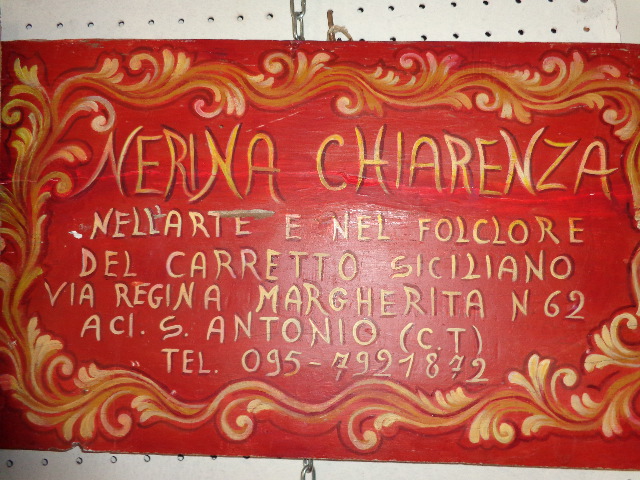
What does a talented woman trying to carry out her trade and passion in a sector dominated my males do? She follows her passion and for forty years Nerina Chiarenza has done just that! Mrs. Chiarenza lives in Aci Sant’Antonio on the foothills of Mt. Etna and she is a Sicilian cart painter. I met with her thanks to Marisa who introduced me to her and I was touched when I entered her studio. As I walked in, I just was in awe at all the exceptional artwork around me and I couldn’t help tears rolling down my eyes. I was just moved by this woman whose passion for what she has done for forty years was so evident in each corner of her studio. Every piece of work in that studio clearly shows the hard, patient and continuous work that Mrs. Chiarenza has carried out . Upon my arrival, Mrs. Chiarenza showed me so many testimonials of her artwork. She pulled out books that have been written about her and newspaper articles written over the span of forty years; all these testimonials of her long career which she has kept and still bring her so much joy.
Mrs. Chiarenza in her younger years in the picture on the right hand side
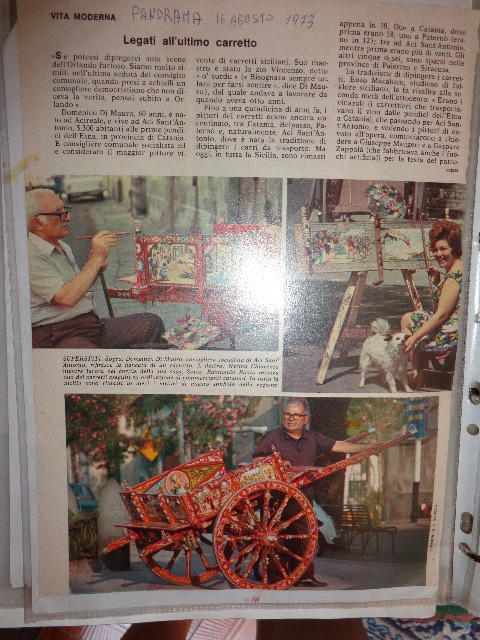
It was when we stopped to look at an article written by an Italian journalist, Gian Carlo Mazzini, that she commented how much the article written by this journalist had meant to her. In his article, written forty years ago in Panorama, Mazzini wrote about the talented artist and what it truly meant to be a woman carrying out her trade in the Sicilian culture. At that time, this trade of painting Sicilian carts was carried out mostly by men and it took a lot of courage for a woman to pursue this path. Mrs. Chiarenza shared with me how her choice had brought many challenges that had made her life not easy and kept reiterating how much the article addressing this issue had meant to her. She said, that in the days when she first started as a young lady, in a town like hers in Sicily, the feeling was that women ” should take care of the home.”
However, it was obvious, that regardless of the cultural expectations, she has managed to carry out a wonderful career and has received recognition for her accomplishments by many.
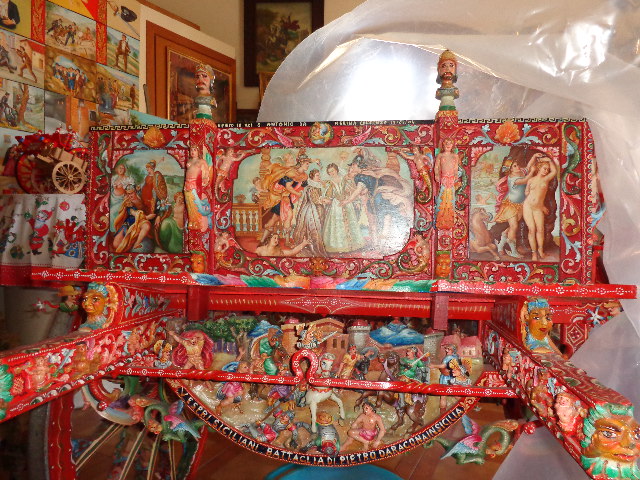
The picture below shows a treasured Sicilian cart in Mrs. Chairenza’s studio. The writing and painting on the bottom of this cart represents “I Vespri Siciliani.” I Vespri Siciliani was a revolt which took place in Sicily in the XIII century. The revolt started at sunset, thus the name “Vespri” from “vespers.” At that time, the land was under French rule; the Angioini ruled and it was a harsh rule. The Sicilian population rebelled and asked the Aragonesi (Spanish) for assistance in fighting the Angioini. The result of this conflict was France and Spain dividing the south – the Aragonesi took Sicily and Sardinia and the Angioini the rest of the South of Italy.
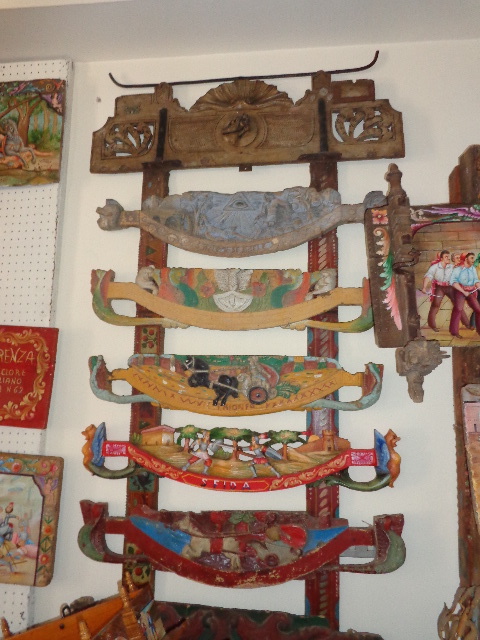
A few examples of doors and side bars of Sicilian carts
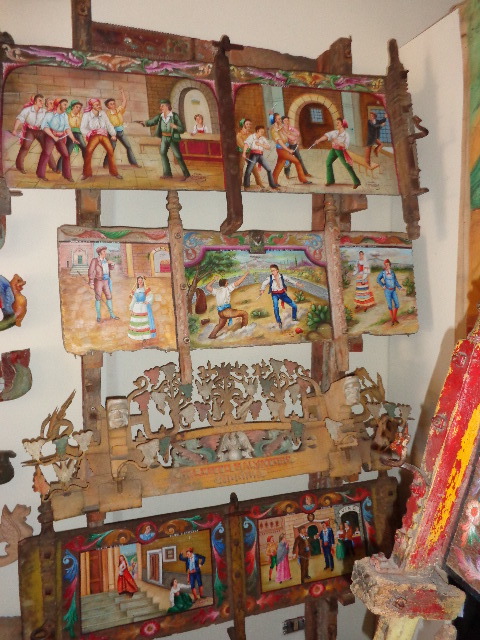
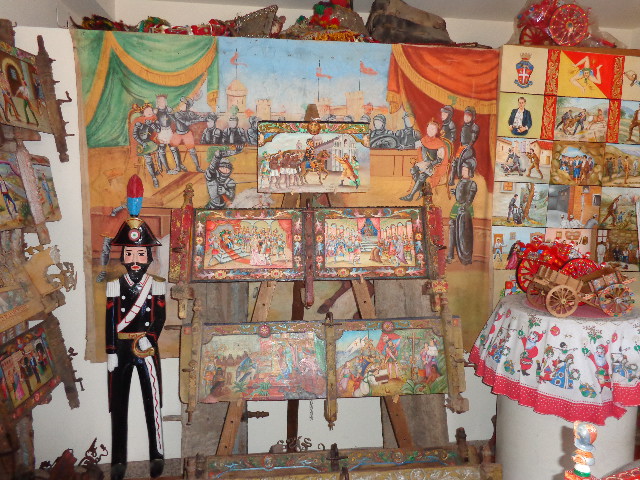
I recently went back to visit Mrs. Nerina Chiarenza, painter and decorator of Sicilian Carts, at her home in Aci Sant’Antonio, and she had just received a letter from the Council Department of Cultural Goods and Sicilian Identity of the Sicilian Region. She happily shared the letter which was a notification to Mrs. Chiarenza that she had been entered in the Registry of Intangible Heritage of the Sicilian Region for her work carried out on Sicilian Carts. The provision had been carried out after an evaluation of her personal skills and mastery proven by her work. This action places Mrs. Chiarenza in the Registry of Intangible Cultural Heritage of the Sicilian Region and is found in the Book of Living Human Treasures. Furthermore, the letter stated that this provision will be entered in the list of Intangible Goods of the Sicilian Region which can be found visiting the following website: www.regione.sicilia.it/beniculturali/reis.
Mrs. Chairenza 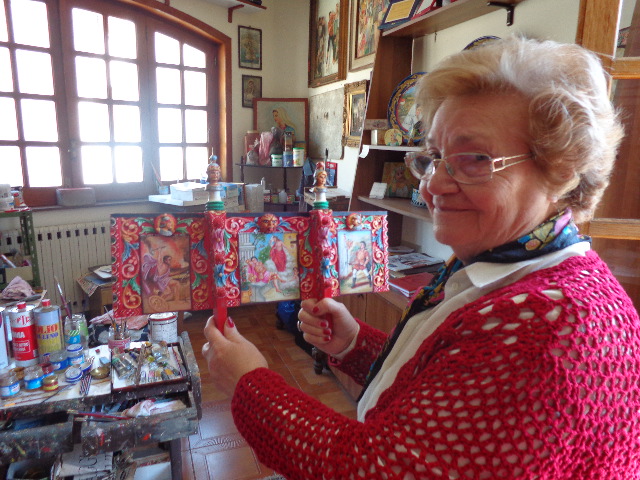
Mrs. Chiarenza’s website can be visited at http://www.nerinachiarenza.it
On a sunny Summer day, accompanied by Marisa, I visited the oldest living Sicilian Cart painter in Sicily, Domenico di Mauro, known as “Minicu u pitturi” ( which in the Sicilian dialect means Domenico the painter). I had contacted Marisa asking if she would introduce me to this artist as she had organized his 100th birthday celebration in his hometown of Aci Sant’Antonio just two months earlier.
As Marisa and I arrived at Minicu’s home, we were greeted by his son, Nello. Walking across the garden, as we arrived in the courtyard, there we found Minicu at work.
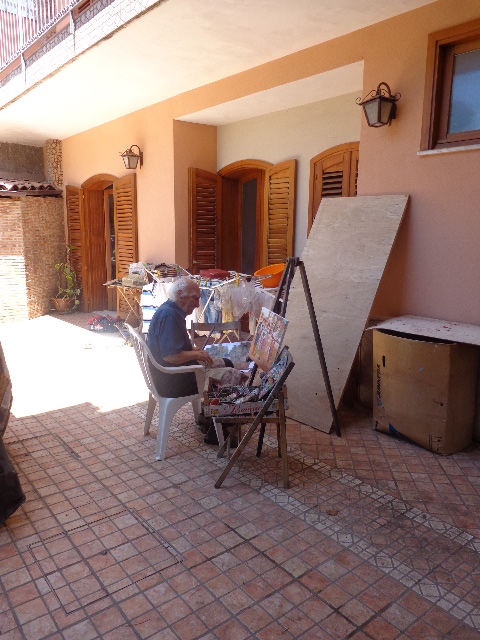
Minicu u pitturi has been painting Sicilian carts for as long as he can remember. The process of making a Sicilian Cart, a traditional vehicle dating back centuries, involves several different artisans each specializing in differents parts of the construction, and the painter is the final one.
The Sicilian cart is mostly made of aged wood, often walnut, and wrought iron on the bottom. The painter who paints the various parts of the cart in rich colors usually paints scenes taken from the traditional popular stories of the land.
The structure of the cart has a flat-bed with sides, a door in back, the front extensions where the horses are hitched, and very large wheels which allow the cart stability. The large wheels were fundamental when these vehicles were the main means of transportation traveling on steep unpaved country roads, quite abundant in Sicily. Over time, Sicilian carts have become an icon of the traditional Sicilian culture and the artisans creating them fewer.
Side view of a Sicilian cart 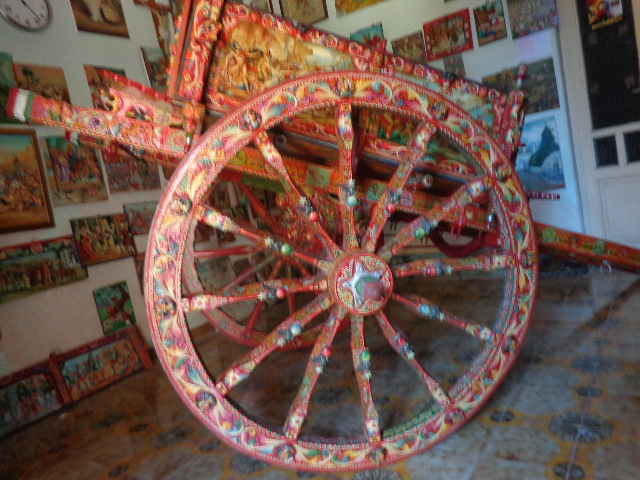
Minicu started his career as a cart painter at a very young age. He is so proud of his accomplishments and very happy to share his passion and his stories. As we started talking, he commented on how many visitors have come, over the years, to visit him and that they have come from all parts of the world. Consequently, he stated, examples of his work can be found in the Vatican, Paris, Moscow, Australia, Canada and Japan.

As I asked Minicu to tell me about his early career, he talked about his initial experiences in the field when he was an apprentice with a “maestro”. In retelling some of the lessons he learned from his maestro, he shared that his maestro would always tell him that it was passion that had to come first and, in his own words, that if the artist had no passion for what they were doing they might as well stay home. Furthermore, his maestro would warn him that through this work of passion the money earned could not be the priority. So, Minicu’s message was that it is only passion that creates a true work of art.
With regards to what brought Minicu into this trade, he stated that he loved painting but had always enjoyed the theatre and opera and wanted to retell these stories through his painting. These paintings depict scenes from the stories belonging to the Sicilian tradition, from literary works, to the actions of the French paladins of the court of Charlemagne, so much a part of the traditional storytelling in Sicily, to stories taken from the Bible.
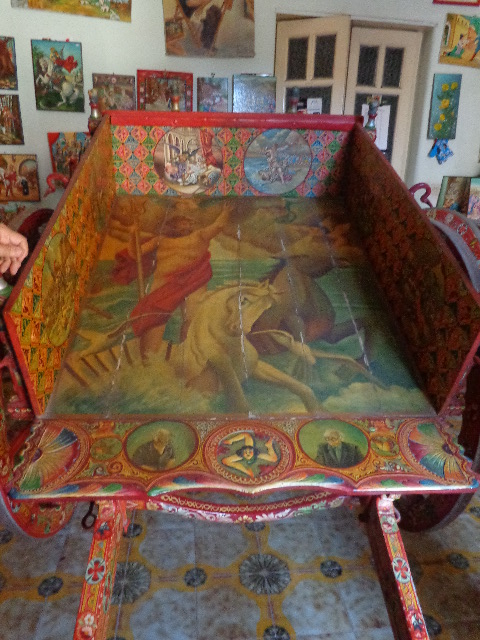
Minicu’s son, Nello, holding a door of a Sicilian cart
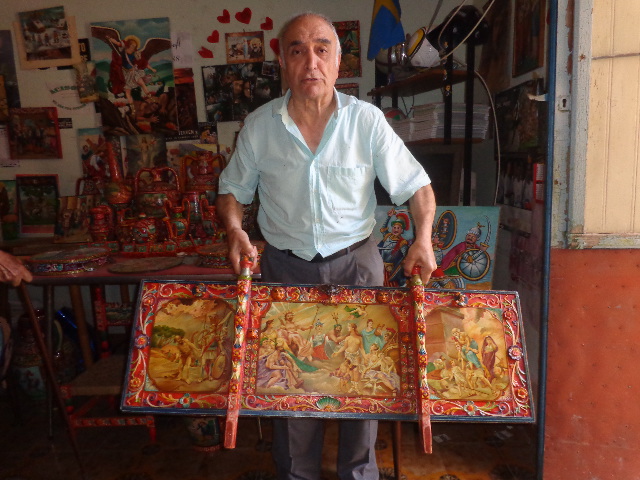
One literary work depicted by many Sicilian artists is Cavalleria Rusticana, a play written by Giovanni Verga, Sicilian playwright and that was also adapted into a melodrama by Pietro Mascagni. The setting of Cavalleria Rusticana is the town of Vizzini, Sicilian country life in the nineteenth century, in a town located inland, on the southeastern part of the island. Cavalleria Rusticana touches on many themes such as love, betrayal, jealousy, and honor and the rules that are to be followed set by the culture.
The painting below depicts the toast that sets the date for a duel between the two male main characters, Turiddu and Alfio

It was truly a pleasure to see a centenarian still actively pursuing what he loves best and happy to share his passion and stories with those who visit his studio. Of course, throughout our visit, his faithful friend stood guard and did not miss a beat!

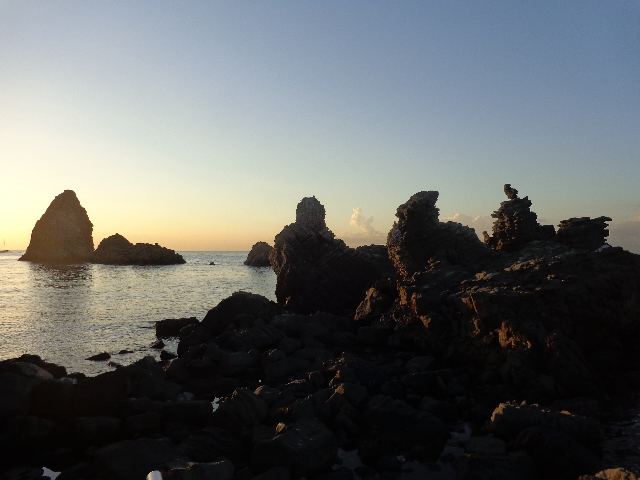
First day of Fall, sunrise in Acitrezza…………..


I Faraglioni – According to legend, these were the rocks thrown at Ulysses, as he was running away, by the giant Polyphemus.


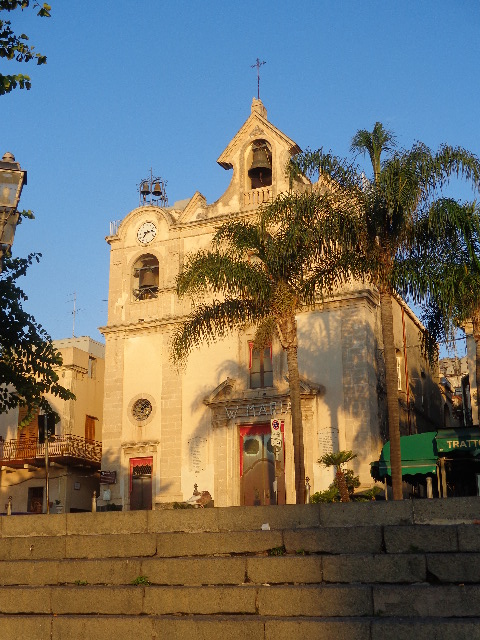
Chiesa S. Giovanni Battista
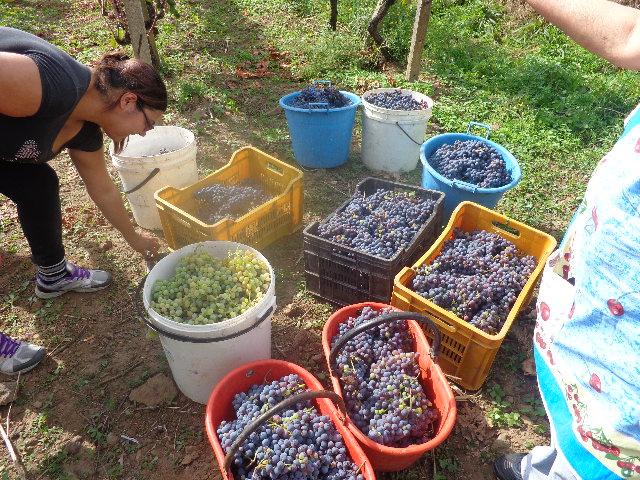
It is so much fun to join some lively folks and harvest grapes. This year, I joined the Messina family and their friends in Mascali and we all had a wonderful time. We picked grapes for about three hours; then the wine making process began in the “palmento”, an old lava rock structure which dates back centuries. The vineyard lies at 300 meters above sea level on the foothills of Mt. Etna. The grapes, Nerello Mascalese, are native to this specific spot. Of course, after the “hard” work, there were 30 hungry folks sitting at the tables enjoying some scrumptious food!
A view of the coast from the terrace of the Messina family home
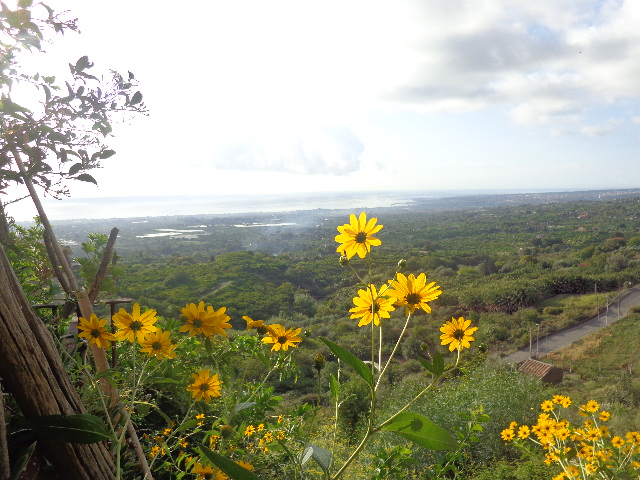
This is a good harvest season!


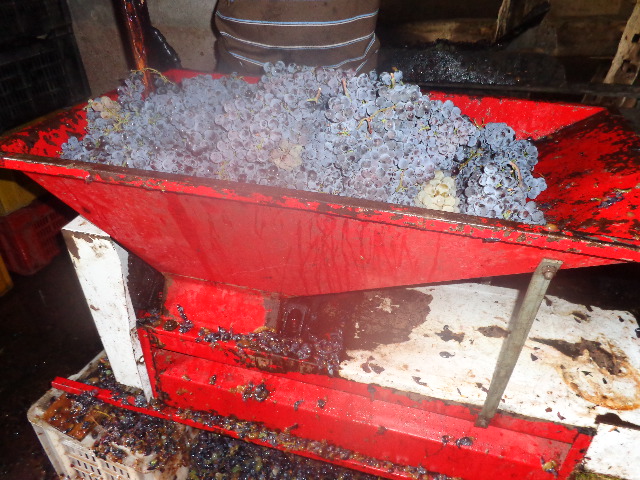
The machine which has replaced “stomping”
Watching the mosto flow into the lava tanks


I’ll be going back tomorrow for the next step in the process
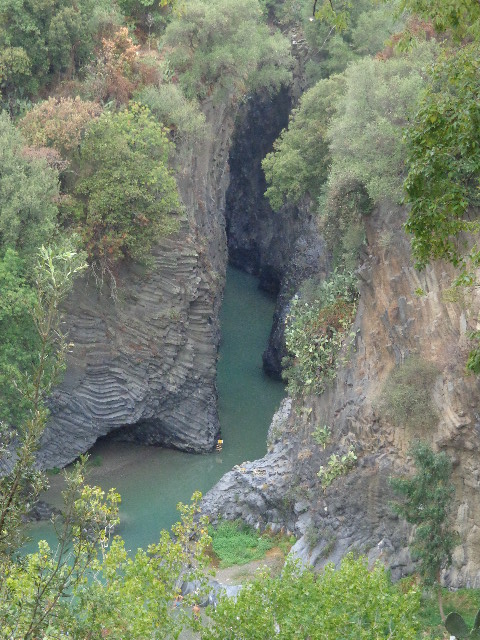
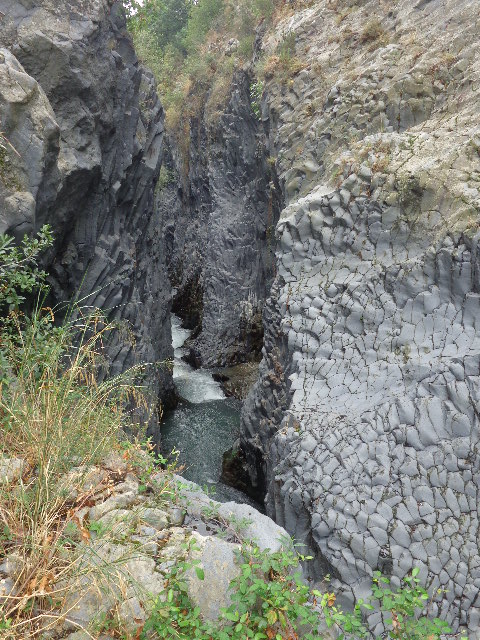
Just a peaceful Sunday walk along the Alcantara Gorge




One year ago, I wrote a post on Monica Fiumara, who runs her family farm, Azienda Jancarossa. At that time, I described Monica’s challenges when her lemon, orange and olive groves were devastated by fire. Back then, when I visited her, I found a lady who shared the sad reality of losing 700 of her 3,500 trees to fire! One statement Monica made at that time, among all the challenges and fear for the future of her crops, was that “She could do it”. Well, she HAS done it!
This afternoon, I visited Monica and saw firsthand what a difference one year can make when one sets one’s mind to overcoming adversity and making a difference. Today, the Monica I spoke to was glowing, her eyes were sparkling and it was clear that she had indeed overcome adversity.
As we sat on her terrace overlooking the property, in retelling the events of the past year, Monica started by talking about those 700 trees that died as a consequence of the fire. The fire spread quickly through one area and bounced over other ones and the trees were affected in three different ways: some died due to the fact that the bark separated, some were totally burnt and some were burnt halfway.
Pulling back the bark which separated from the tree trunk at the time of the fire

However, as I spoke to Monica and we started walking around her property, all she kept saying was that this past year has been a lucky one.
The previous year, there had been loss due to rain at the time the trees were blossoming and there was loss in production due to the fire which killed one-fourth of her trees. Yet, with regards to the trees that survived, the yield this year has been great and Monica has been able to sell her produce very well.
While walking through the property, I could see the vacant land where the damaged trees are being uprooted. Monica has managed to hire a woodcutter who has uprooted the dead trees on a barter system; the payment for his labor is to take the wood. Seven hundred trees have been removed out of the 3,500 on the property.
The clearing shows one of the areas the fire ran through burning the trees

Furthermore, change and renewal are today the positive result of what had been adversity in the past. Now, Monica has devised a new plan. After research and study, she is planning to start growing avocados on the land where the dead trees once stood. She is studying avocado production practices in countries as Peru’ and Chile and is acquiring more knowledge on the topic through an avocado research center located in the northern part of Sicily, in the town of Caronia.
As I met with Monica and spent time talking to her, the twinkle in her eyes clearly showed her feeling of happiness. She has overcome adversity and managed not only to react to it, but to grow both as an individual and a professional.
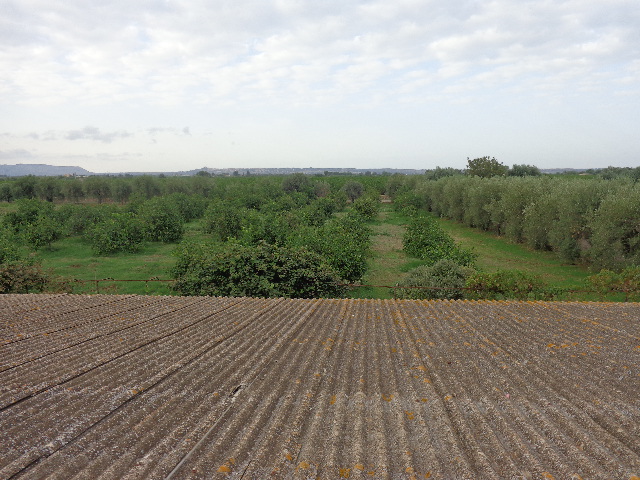
Some of the trees that survived the fire as seen from the terrace
“Fresh activity is the only means of overcoming adversity.” Johann Wolfgang von Goethe
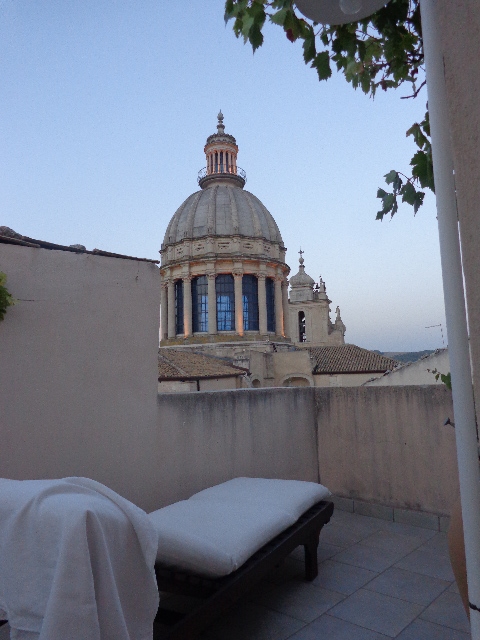
S. George’s Dome seen from a tiny rooftop terrace
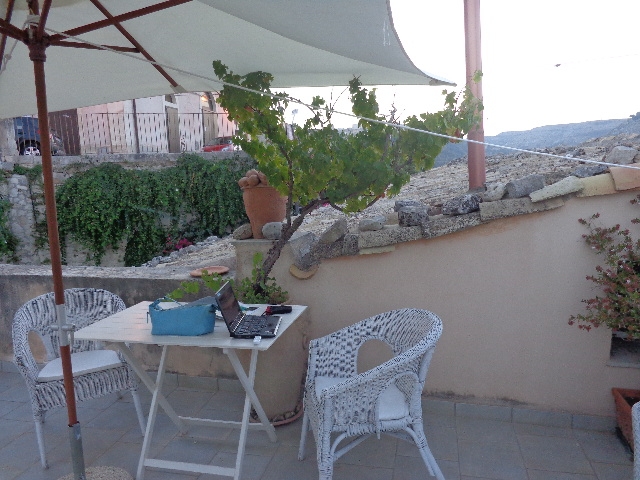

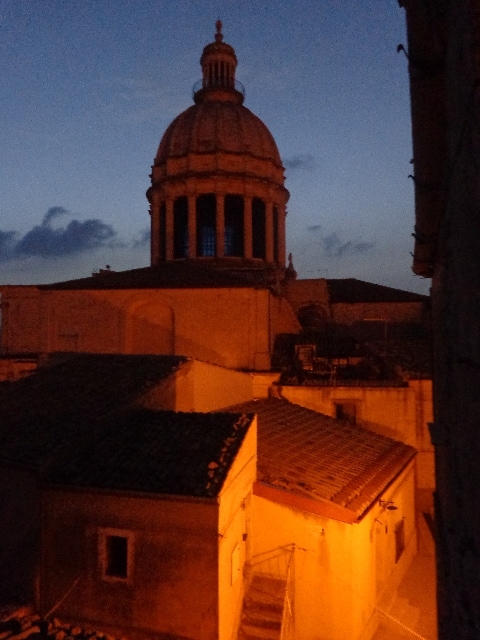
Up here, church bells tolling and birds chirping! 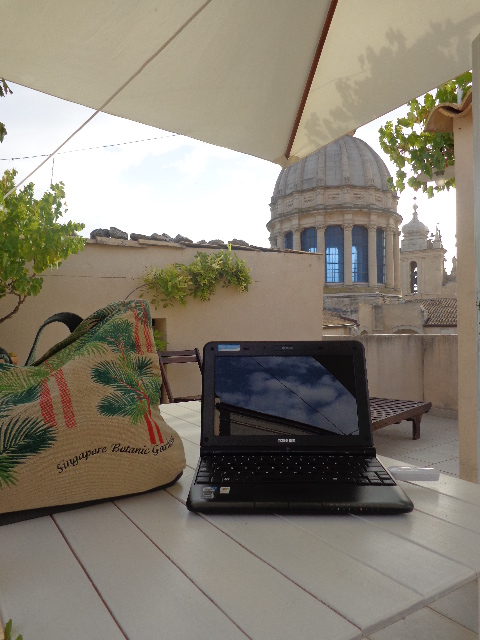
This post is not on Sicily.
The European Commision is carrying out a campaign, “Stop Food Waste”, which has the purpose of bringing awareness to the topic of food waste. In Europe, 180 Kg of food is wasted per person per year. This year, EPCAS, European Party Caterer Association, held their Summer meeting, in Pordenone, Italy and the topic was “Stop Food Waste” .
Some old friends of mine, the Martin’s, who run Prosciuterria Martin in Pordenone, organized a food and wine tasting event for the EPCAS Summer Meeting participants and asked me to join them and lend a hand.
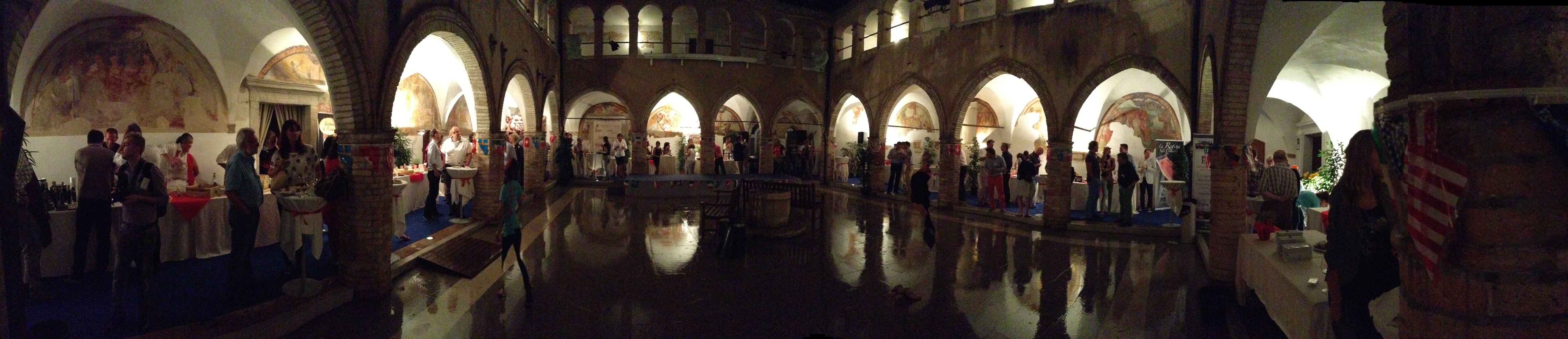
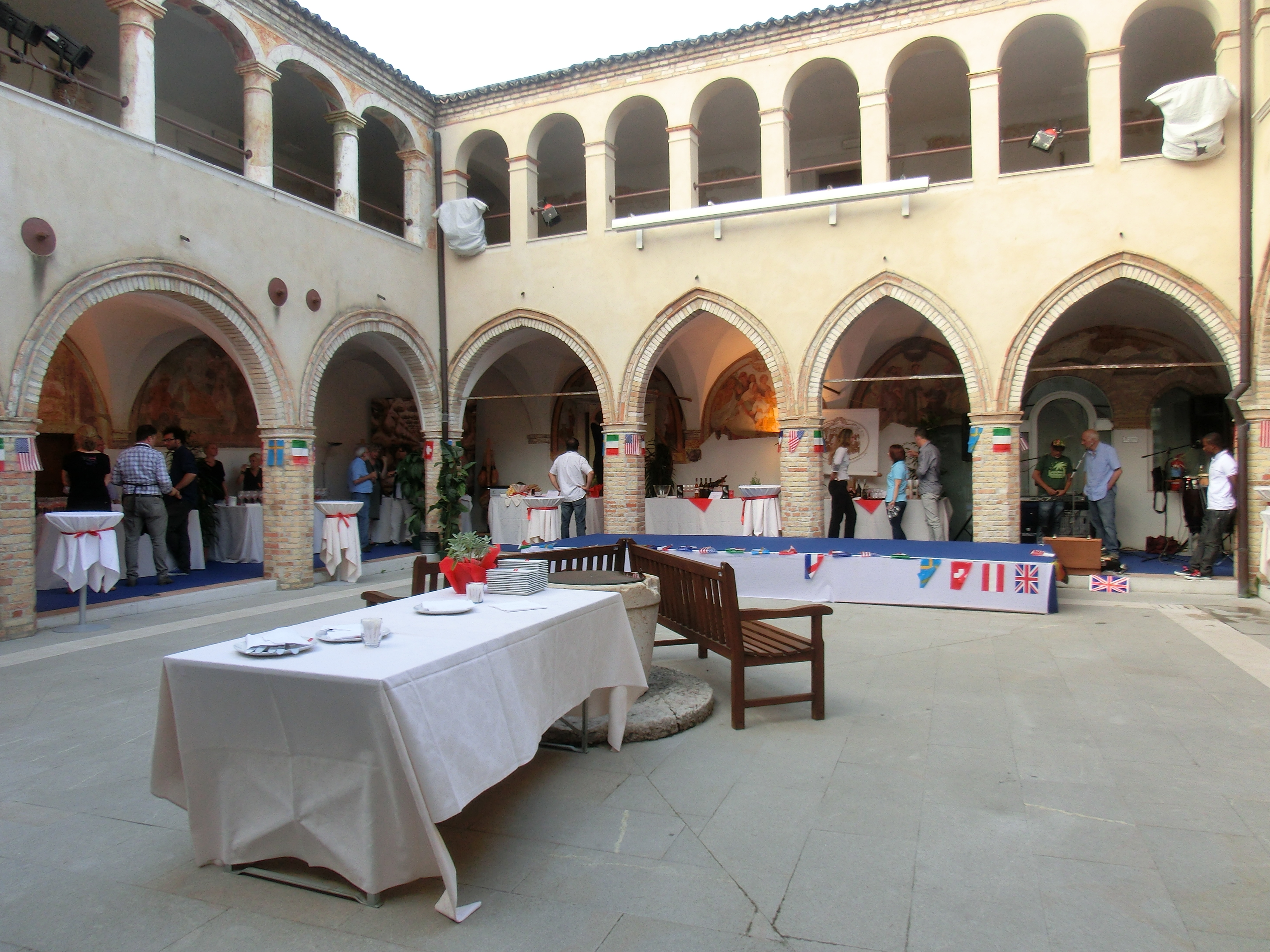
The food and wine tasting took place in the cloister of an old convent dating back to the XIII century, in Pordenone. Local wine and food producers participated sharing their products and original recipes. This was an opportunity to share Italian culinary products, presented by the producers themselves, to the EPCAS group, owners of sixty companies coming from all over the world.
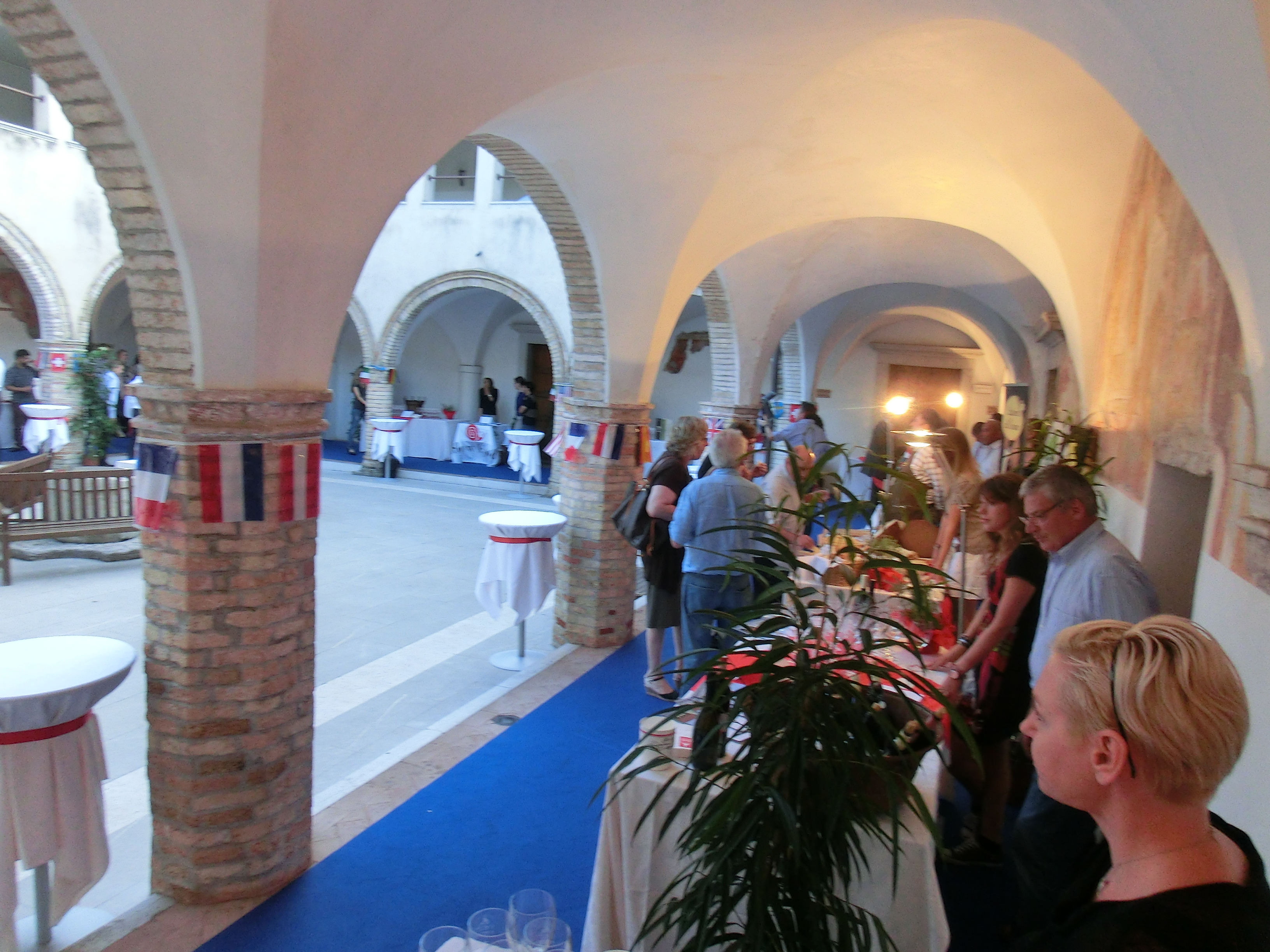
The evening was quite enjoyable as people mingled and tasted a variety of foods and wines accompanied by music. Not even a sudden downpour could stop everyone from having a wonderful time.
The menu and the names of some of the local producers that participated in the food and wine tasting event:
Lovison:
salame friulano con pane e crostino con il lardo
local pork salami with bread, toasted bread with bacon
dalla cucina: tartina di pane tostata con il muset e salsa al cren
toasted bread with muset (boiled sausage) and horseradish sauce
Latteria di Aviano:
assaggi di formaggi tipici della latteria
samples of local cheeses
dalla cucina: il frico
frico: regional dish made of cheese and potatoes
Dok Dall’Ava:
due tagli di prosciutto di San Daniele Dok abbinato ad un bocconcino di melone
two different San Daniele Prosciutto Crudo with melon
Vicenzutto:
tartare di carne bovina servita con pane tostato e le fantasie di Vic
beef tartare served with toasted bread and Mr. Vic’s fantasy
dalla cucina spiedino Pordenone
skewer Pordenone
Friul Trota:
gli sfiziosi assaggi delle specialità di Pighin
Mr. Pighin’s delicious samples
dalla cucina la tartare di trota dolce fumo, zucchine, riso Basmati e basilico
tartare of smoked trout, zucchini, rice and basil
Valsana:
Gran Kinara formaggio di vacca stagionato fatto con il caglio vegetale “Cardo”
Gran Kinara seasoned cow cheese prepared with vegetable rennet
Prosciutteria F.lli Martin:
dalla cucina: risotto all’onda alle zucchine e fiori di zucca
con gran Kinara ed Extravergine dei Dogi
creamy risotto of zucchini and pumpkin flowers with Gran Kinara cheese and Extra virgin oil “dei Dogi”
gnocchi di patate fatti in casa al figomoro
Potatoes home-made gnocchi with black figs from Caneva
Esquimau:
Stuzzichini gastronomici freddi: Nuvoletta di Verduzzo, aperitivo al gelato di latte caprino e nuvoletta di Verduzzo. Ricoperto al Montasio, tramezzino al mantecato di Pitina e scaglie di Montasio.
cold appetizers
Agana: gelato di mandorle siciliane con inserto di albicocche all’Asti e amaretti.
servito con Alba Traminer passito Borgo delle Oche
almond ice cream with an apricot sauce
served with Alba raisin wine from Borgo delle Oche
Photos:
The cloister where the wine and food tasting took place – Photo courtesy of Ms. Beijsens, organizer of the Summer Meeting
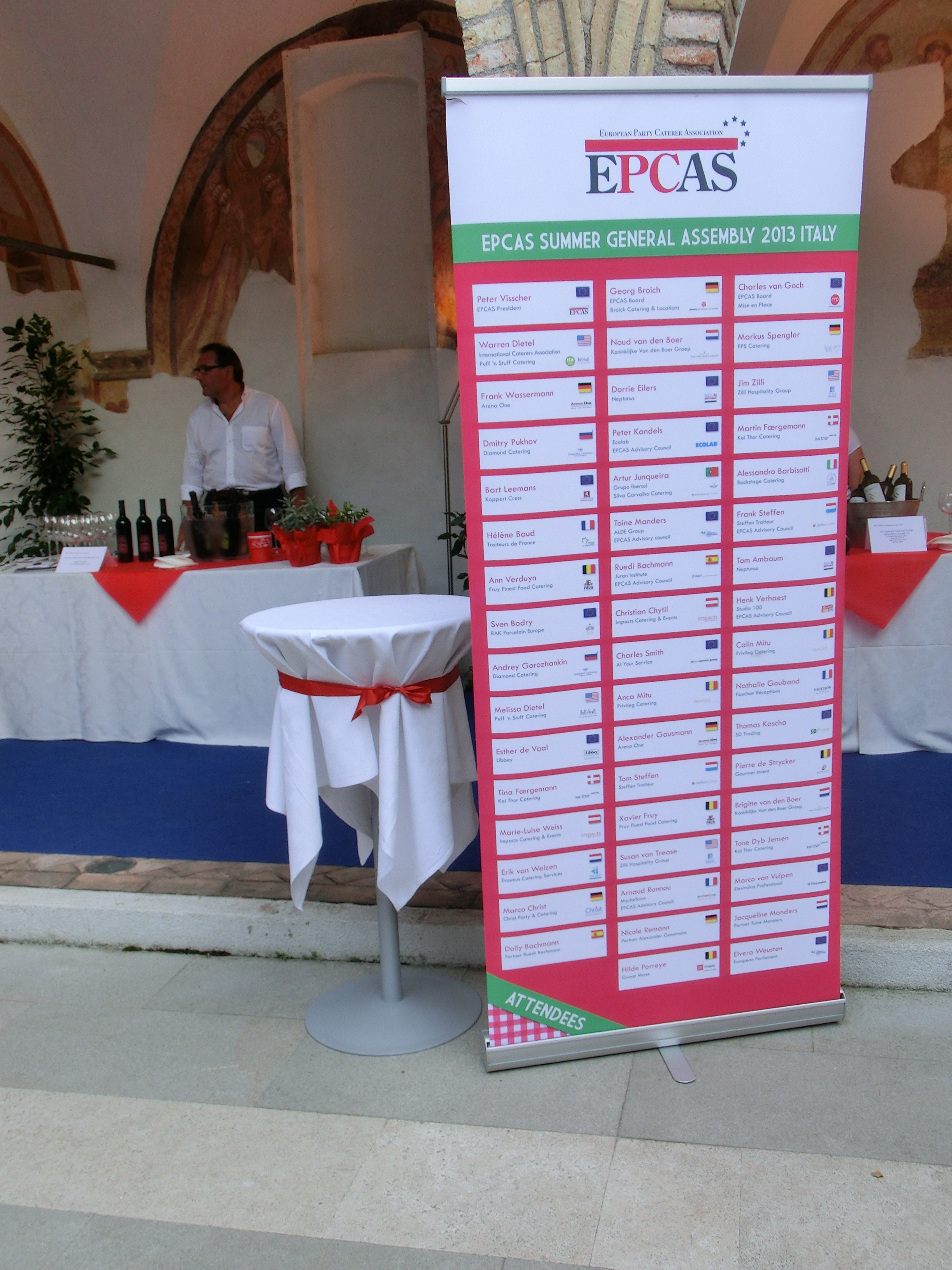
EPCAS Participants list
Getting ready for the tasting
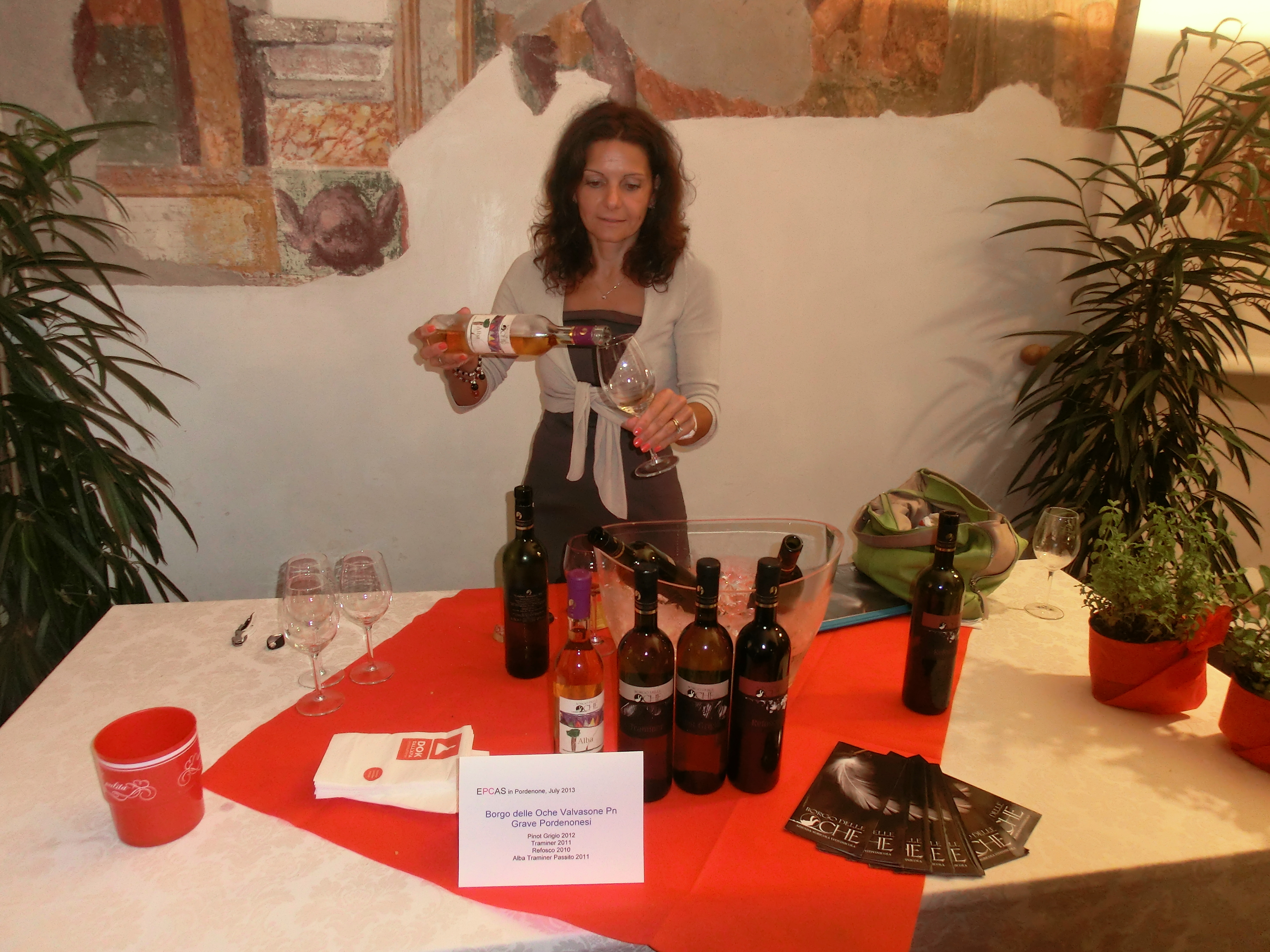
Borgo delle Oche owner
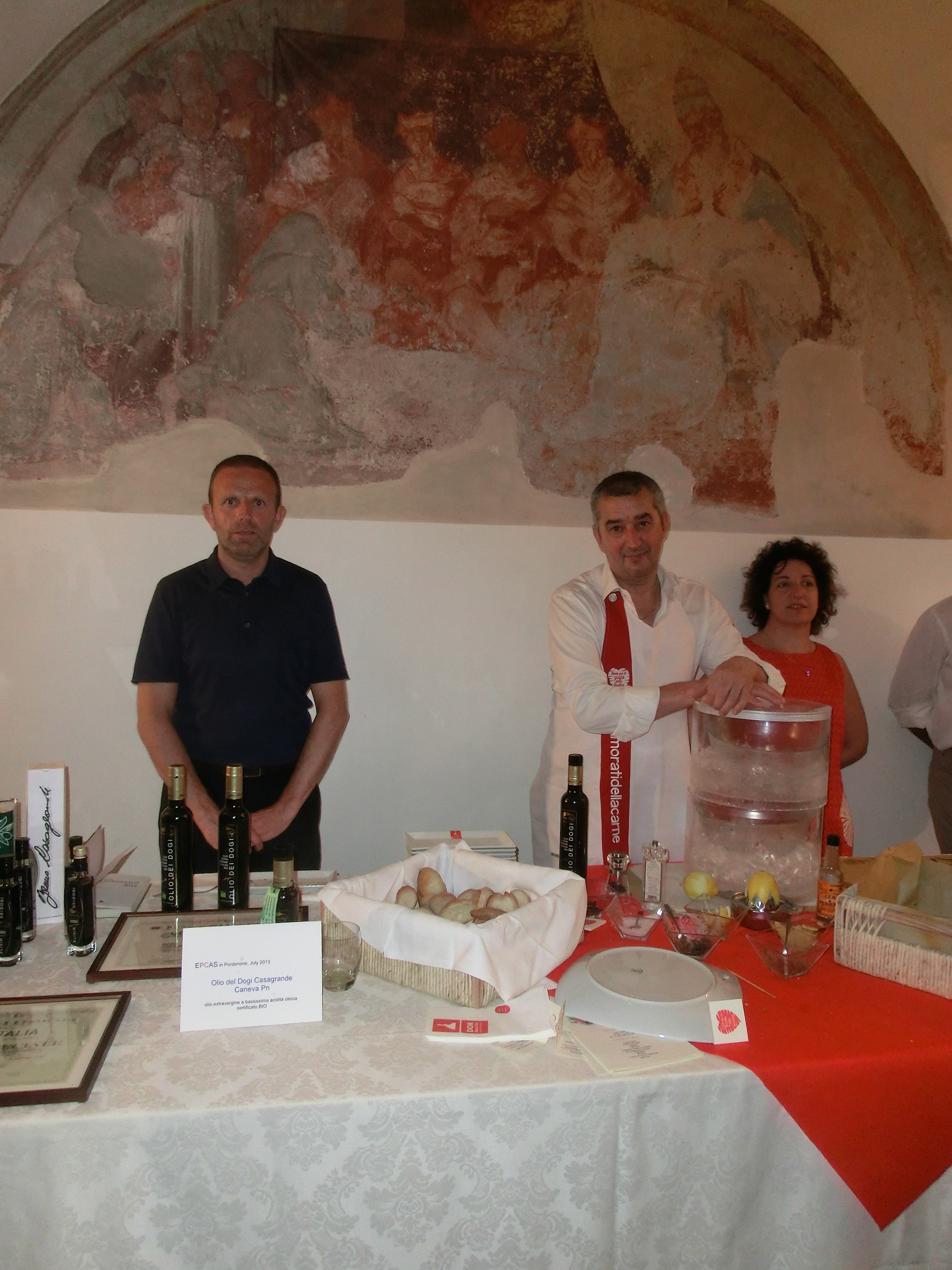
Mr. Casagrande and Mr. and Mrs. Vicenzutto
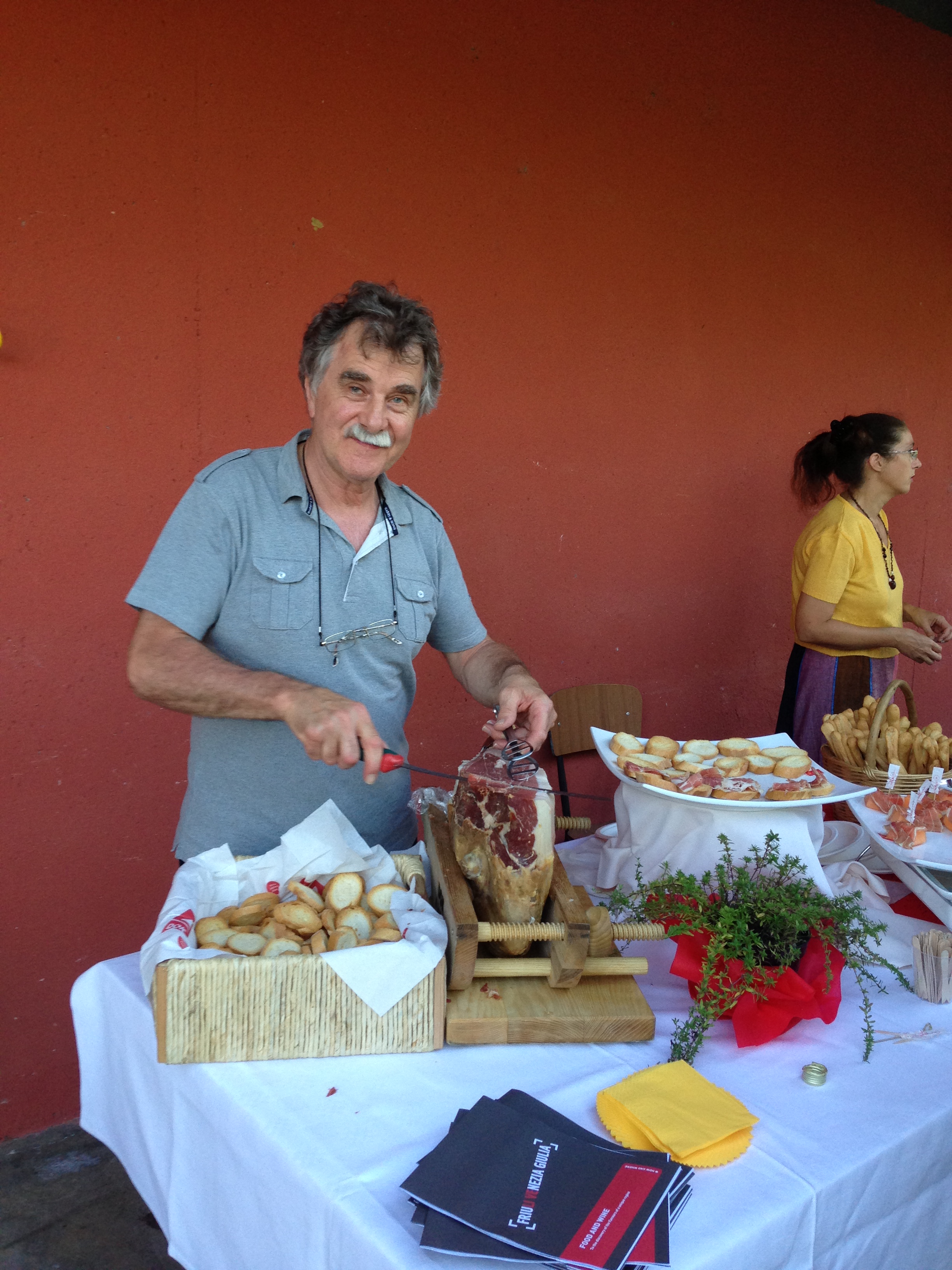
Sergio Martin hand slicing prosciutto
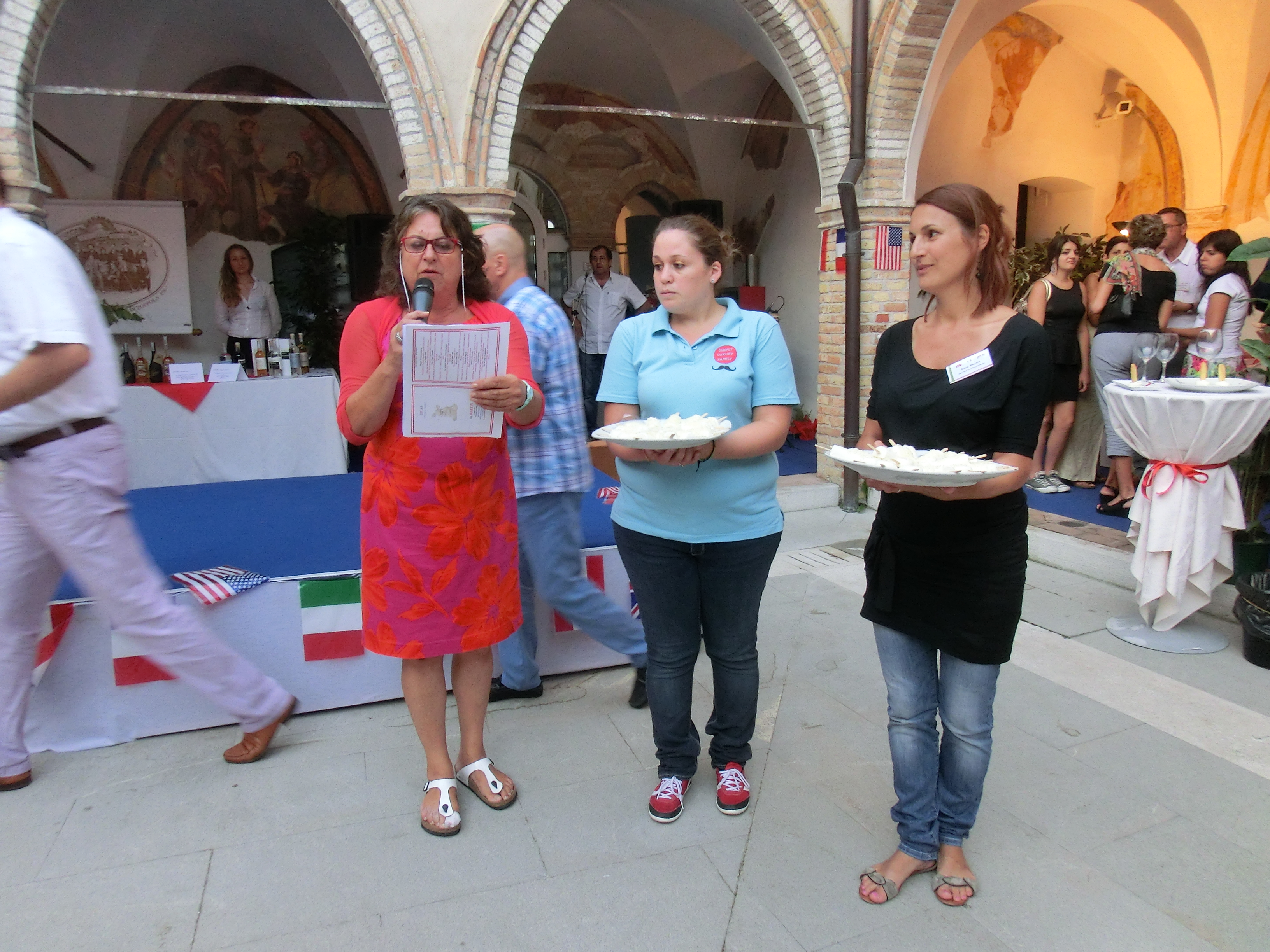
I, presenting one of the dishes, Martina and Elisa carrying the trays
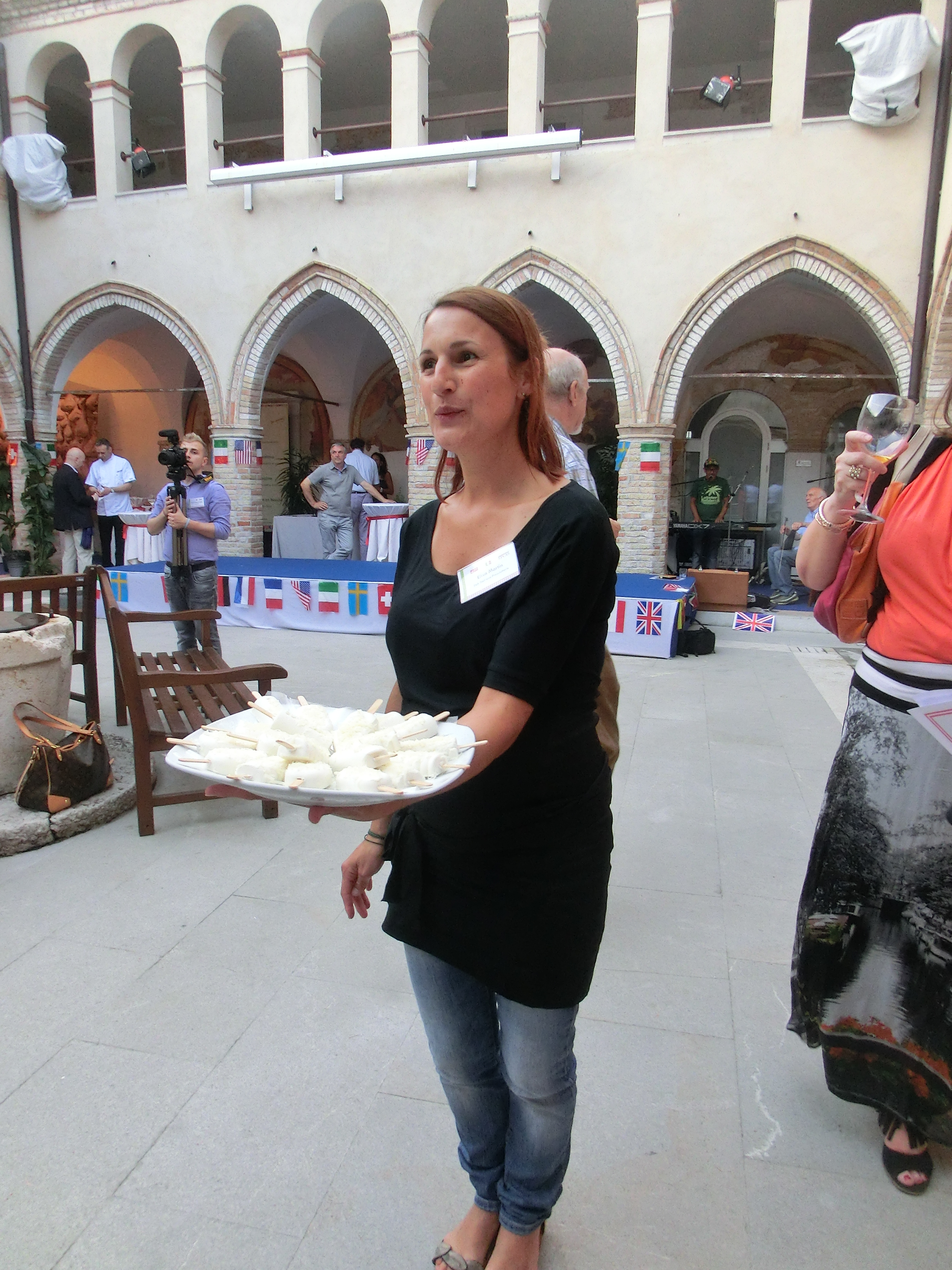
 H
H
Elisa Martin
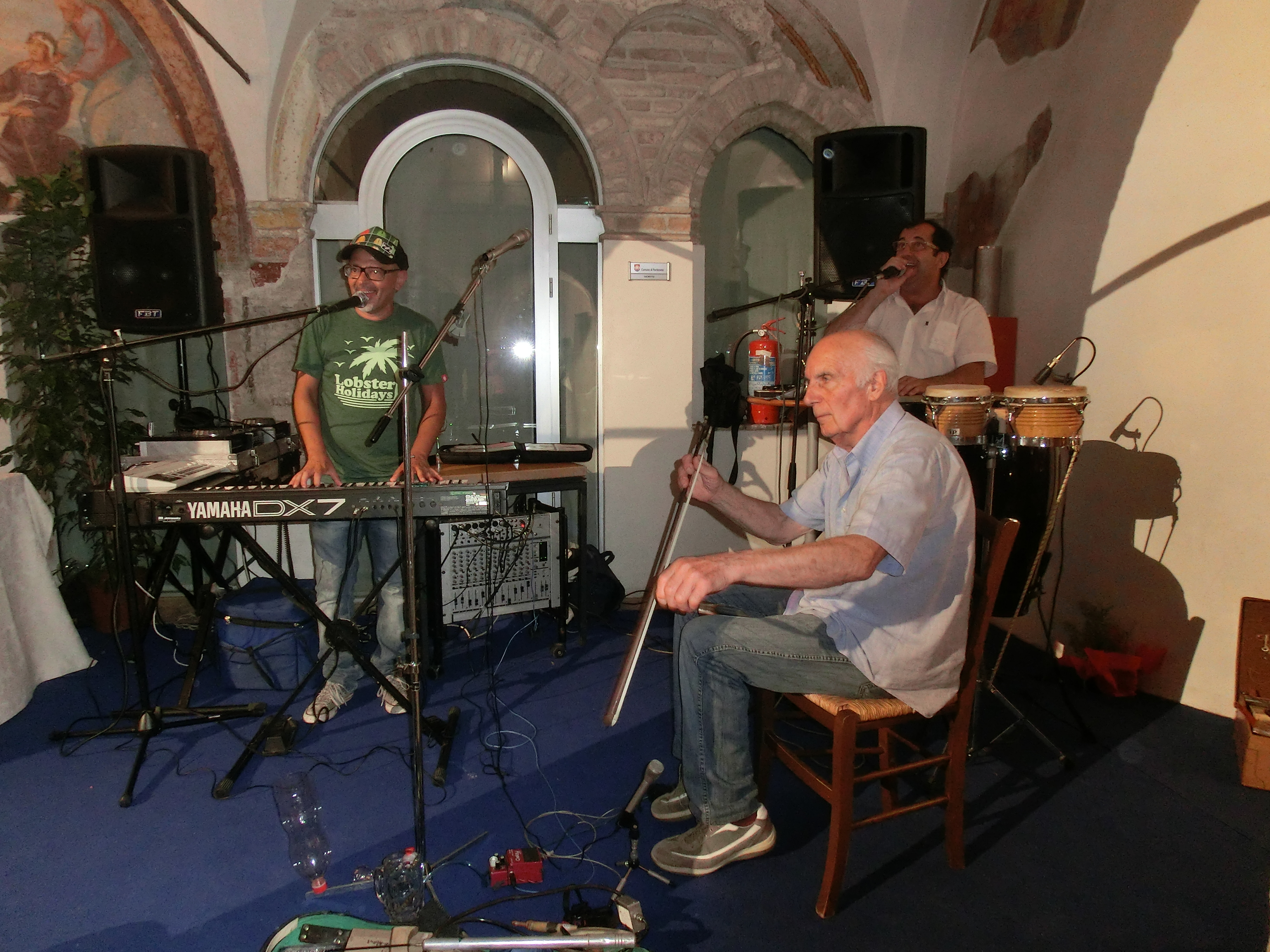
Musical group
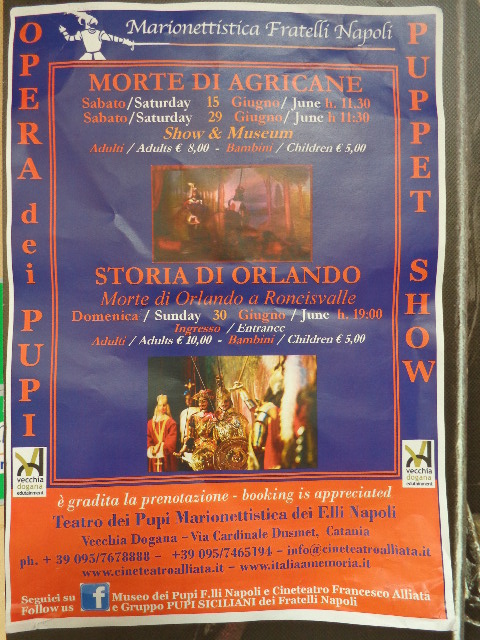
I have always been fascinated by i Pupi Siciliani, Sicilian Puppets, and took my own two with me when I moved away from Sicily in 1981. Over the years, they have hung in my homes and reminded me of one major Sicilian tradition.
Recently, I attended an “Opra de Pupi”, a puppet show, performed by the Napoli Family in Catania, had a pleasant conversation with Davide Napoli (one of the nephews) and his uncle Giuseppe (one of the uncles) and visited their Pupi museum.
The Napoli family pride themselves in the fact that they have been Sicilian puppeteers for four generations, without interruption. They mentioned that they have been a role model for other pupeteers on the island. When there had been an interruption in the pupi tradition of other pupeteers, those who would start over would look to the Napoli family for inspiration.
Besides the artistic expression of putting on the puppet shows, the Napoli family handle the construction of the puppets themselves, from start to end including the sewing of the costumes, which traditionally is carried out by the women in the family. I quote Davide who told me that the puppets become part of the family and in his own words: “I give you life, but you give me emotions.” However, they believe that not only emotions are given, but the puppets have actually modeled a behavioural code to its audiences, as stated by Uncle Giuseppe.
Following are some excerpts from the Demetra Guide, SICILIAN PUPPETS – History, art and tradition of the marionettes in Sicily, almaeditore (publisher) available at the Napoli family museum:
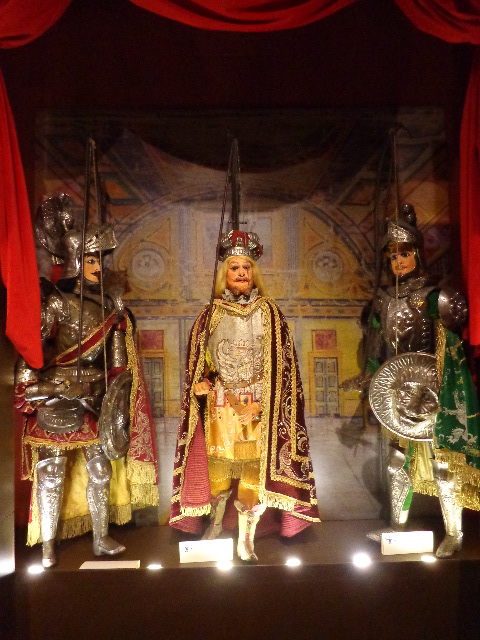
“The Sicilian Opera dei Pupi (Opra) is a characteristic theatre show in which the puppets, manouevred by the pupeteers on specially created stage-fronts, portray the deeds of the greatest medieval heroes, real or legendary, who defended Christianity against the Saracens. In particular, the most recurrent theme was the battle between Carlomagno’s heroes and the Muslim warriors who, invading the Iberian peninsula, threatened the French reign and the whole of Christian Europe…..The Sicilian marionettes were in fact covered in elaborate metal armouor and the pulling thread of the right hand was replaced by an iron rod, which allowed the marionette to make more direct and precise movements, especially during battles and duels…..Starting from Palermo and Catania, the Opera dei Pupi spread around Sicily to such an extent that at the end of the 19th century almost all towns boasted their own local puppet companies…..The oldest and most depicted subject of the Opera dei Pupi is the famous rout of Roncisvalle, the historic battle where Carlomagno’s troops were defeated in 778 in Ara b-occupied Spain.”
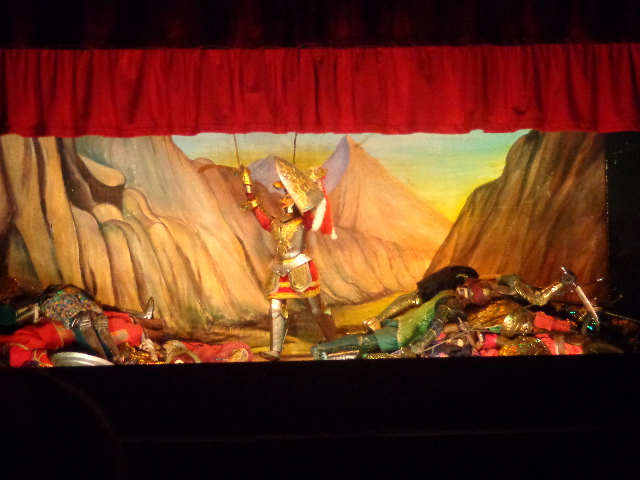
When I visited the Napoli family theater in Catania recently, I saw the performance of the battle of Roncisvalle one of the most important battles, which culminates in the death of Orlando. The title of the show was “La Storia di Orlando.” The theater was packed; there were spectators of all ages and I was so impressed to see the younger spectators so engaged.
Before the show, during my conversation with Giuseppe and Davide Napoli, they had pointed out that in the past the plot of the performance I was about to view would be stretched out into seven weeks of performances. During the past century, these puppet shows represented evening entertainment for the entire family and audiences would visit the theater on a regular basis engaged in the development of the plot over several weeks.
The Napoli men also pointed out to me that each city in Sicily followed its own traditions in the creation of the puppets and the shows. These shows would be developed differently in each city and even influence aspects of the local culture. One example David mentioned is that in the dialect of the city of Catania when one states ‘successi a valli”, which means that something aweful has happened, “valli” refers to the valley of Roncisvalle where Orlando died.
Following are some pictures I took at the Napoli family puppet museum and during the performance of La Storia di Orlando.



Four generations of Napoli family immediately after the performance. In center, with a light blue cardigan, bowing, is Great Grandmother, in her eighties, who still lends her voice during the show.
 Sicily & MORE Explored by Rosanna