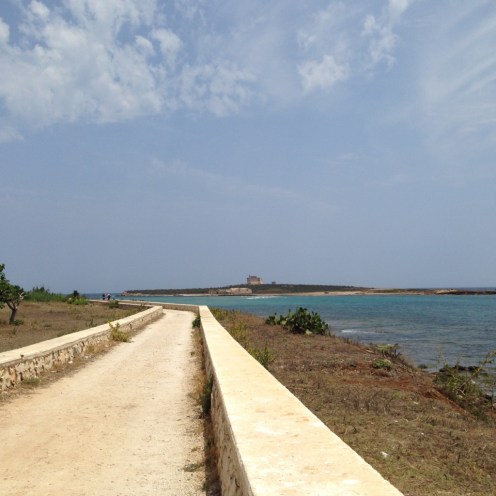
One of my favorite coasts in Sicily lies on the southernmost tip, where the Ionian and Mediterranean seas meet. The town of Portopalo, an old fishing town, lies along that coast. I return to this location as often as I can and enjoy my walks along various parts of the coast. This summer, I found a path I had never seen before, arriving on the coast from the centre of Portopalo. Parking the car down one of the roads reaching the coast from center of town, I found a gate through which I accessed a paved path which snaked its way along the coast.
Entrance point to the path along the coast

Quiet path along the coast
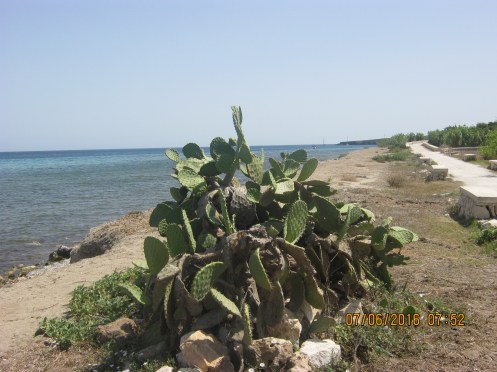
Fabulous uncrowded beach on a summer day

Simply beautiful!
As I reached a corner along the path where you turn and head to the final part, I made an interesting encounter. There was a refreshment stand, but it was a unique one. The refreshment stand was a vehicle, APE, which one sees utilized for a variety of transportation purposes in Sicily. However, this one had been set up as a refreshment stand, but one advertising refreshments belonging to Slow Food. Slow Food is a global organization that was founded in Italy in 1986. It basically represents the opposite to fast food and promotes local, sustainable foods and small businesses. Here was a refreshment stand with the Slow Food logo. When I stopped to get my espresso and talk to the owner, he informed me that he was proud to state that he is the southernmost Slow Food vendor on the entire island of Sicily. He even had signs hanging on the fence next to his stand stating this fact.

I stopped to talk to the Slow Food refreshment vendor, Mr. Paolo Zuccarello. He shared stories about his childhood and was so proud of his family traditions in the town of Portopalo.
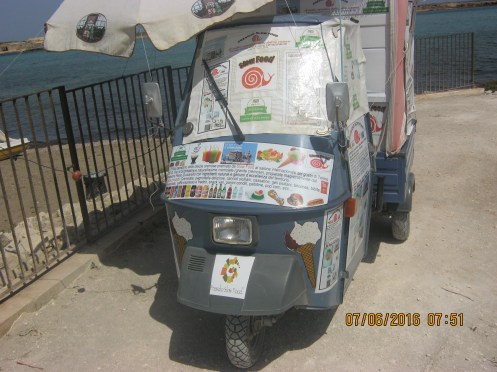
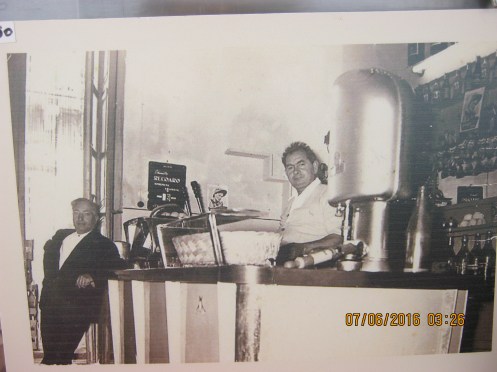
Mr. Paolo was very proud of the fact that his family had owned the very first coffee shop in the town of Portopalo.
Below is a picture he displays in his APE of the very first coffee shop in the town of Portopalo owned by Paolo Zuccarello’s family.
Another picture Mr. Paolo shared with me was the one below. Paolo Zuccarello as a young boy on a donkey drawn cart accompanied by his grandfather. 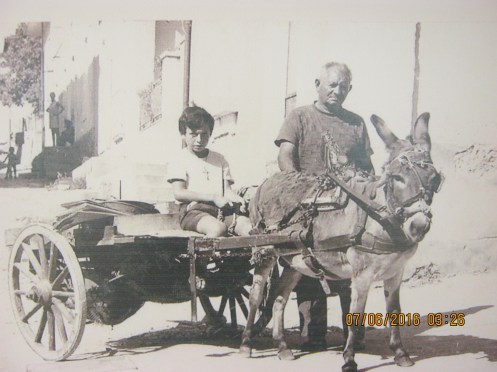
I must say I never cease to enjoy the inventive and friendly people I meet as I travel around Sicily!!!!!
When it comes to exceptional food, ‘U Saracenu Restaurant in Portopalo has it!!!! I was talking to some guests I met at the B&B, Christina and Claudio, when they asked me to join them for dinner at this restaurant. I had no idea what I was about to experience! The food is exceptional and it is obvious that great pride is taken in each step of its preparation. As Claudio and Christina have been returning for years to this location from their hometown of Verona, they knew the staff. Consequently, I had an opportunity to talk extensively to the Chefs, Angelo, Andrea and Mario and to the delightful waitress, Luana. As I talked to the staff, I realized how much passion and loves goes into the preparation of the food, and I must say, it truly shows!!!!
Following are photos of some of the dishes prepared by these wonderful Chefs. Their creativity is outstanding and choose to continuously experiment and create great new dishes.
Photo below – Sign of name of restaurant – ‘U Saracenu -Next to the sign is a Nassa, one of the Sicilian baskets utilized in fishing.

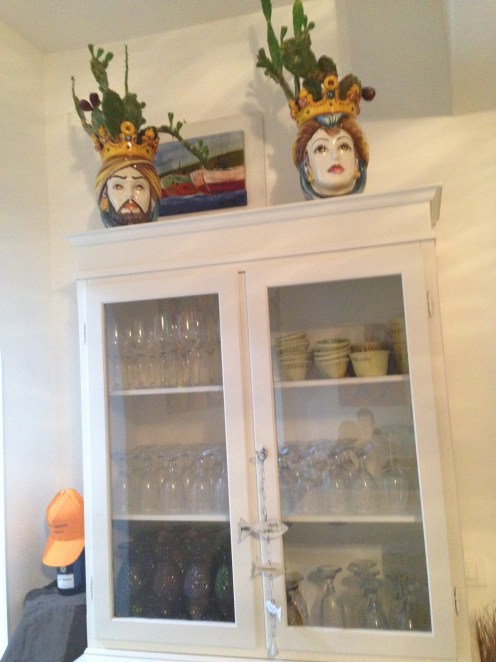
Teste di Burgiu – Sicilian Ceramic Pots tied to a Sicilian Legend connected to the Saracens
Paintings around the restaurant by artist named Fiore

Fiore painting

This “antipasto” is beyond words;
from left corner, counterclockwise are eggplant parmigiana with sardines; octopus with potato sauce; beccafico=stuffed fresh anchovies; tiny arancino; polpetta made with sea bass, potatoes and mussels; caponata; roasted peppers.

Closeup of parmigiana

Bucatini with wild fennel and anchovies – Fabulous!!! I had not ordered a first course, but Angelo made them and brought them to me.

Paccheri with dried tuna roe, pistachio, tiny shrimp, cherry tomatoes – Exceptional!!!

Tartare with red shrimp, rose tiny shrimp, and tuna in a mango sauce –

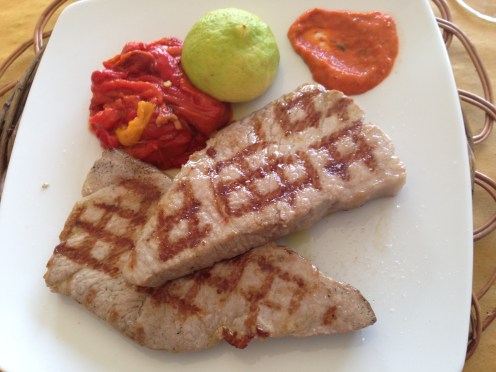
Grilled tuna
Fried mixed seafood – I ate the grilled fish, but heard the fried dish was superb!

Gelo al limone – Lemon gelo

Parfait di mandorla – Almond mousse with chocolate sauce

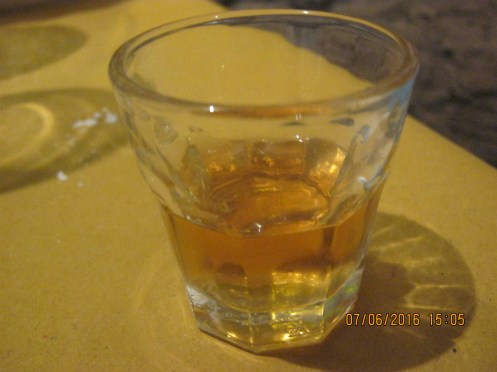
Top it all off with AMARA, an orange after dinner drink!
To top off all the exceptional food, the restaurant is perched up on a hill overlooking the turquoise sea of Portopalo!!!!!!!
On the southernmost tip of Sicily, just a few miles from Isola delle Correnti, where the Ionian and Mediterranean Seas meet, stands a bed and breakfast which offers its guests a magical break from the hustle and bustle of modern life. Casacavarra lies in the countryside and as a backdrop offers the peaceful view of the sea. The owner, Mario, and his assistant, Sandra, go out of their way to offer true Southern hospitality. Guests can choose to dine at the B & B in the evening on some days and that is when Mario puts his culinary talents to work.
SP 8 Pachino-Maucini where B&B is located – this is located after Portopalo

Main entrance to B & B

Entering the B & B
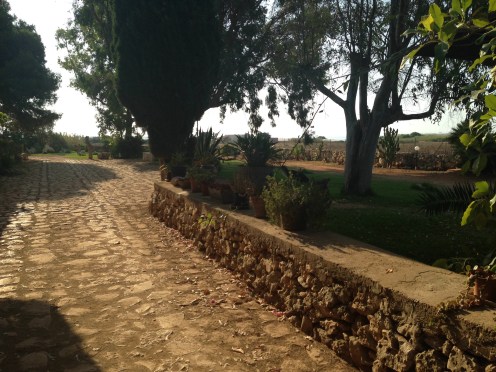
One view of the garden

My favorite view of the garden with the sea in the backdrop

One of the sitting areas in front of the kitchen with the window seen in the picture.

Sitting area

Relaxing close to the kitchen may result in a culinary surprise tasting if Mario is cooking

Returning from the beach you may be treated to an arancino

And while eating your arancino you may suddenly have a Fan club!

Mario’s Pasta alla Norma
‘
Mario’s Rigatoni with Wild Fennel and Anchovies topped with Roasted Breadcrumbs

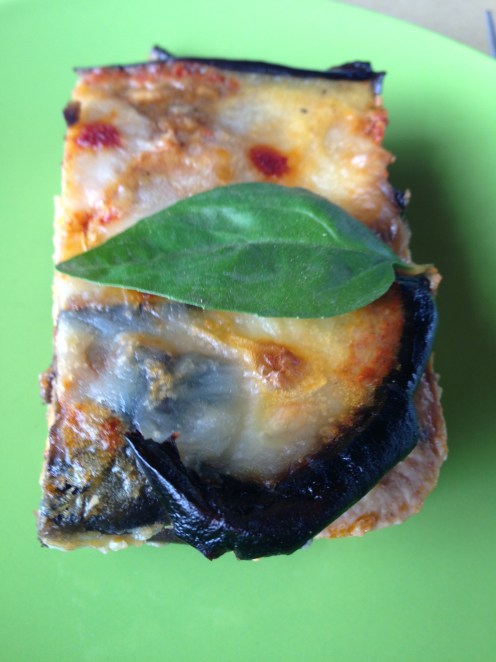
Mario’s Fabulous!!!!! Eggplant Parmigiana
Casacavarra at night

One sign that Casacavarra offers its guests a wonderful experience is validated by the fact that many of the guests I met there have been coming back for years!!!!!
Food Festivals abound throughout Sicily, especially in the Sumer months. When I learned that on the last weekend in June, 2016, the Pro Loco of the town of Marzamemi would hold the Second Sagra del Pesce Azzurro, the Pesce Azzurro Festival in Marzamemi, I planned to attend. I was hoping not to get stuck in a crowd, which is one experience I choose to avoid. Indeed, even though the event was taking place in Marzamemi, located on the southern portion of the Eastern coast of Sicily,village which is usually crowded in July and August, on this occasion the village was not crowded.
I strolled through the village center, a tiny ancient seashore village dating back to the Arab era in Sicily, and famous for its Tonnara, tuna fishery, where the sandstone low houses have been turned into boutiques, restaurants and cafes. I found the Sagra being held in a quiet, private corner, away form the center of the village. The Pro Loco of Marzamemi, a non profit which promotes events tied to the traditions of the land, was sponsoring the Sagra. As I was waiting for my turn to be served the scrumpcious two course meal, I was able to join the cooks and take photos of their talents at work.
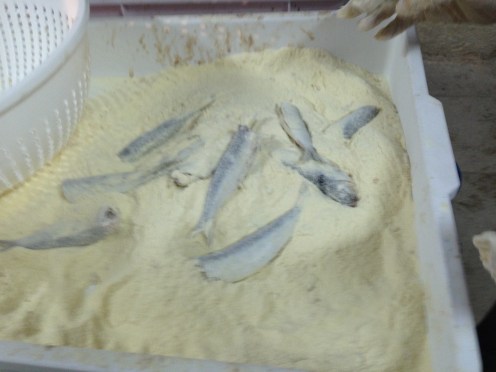
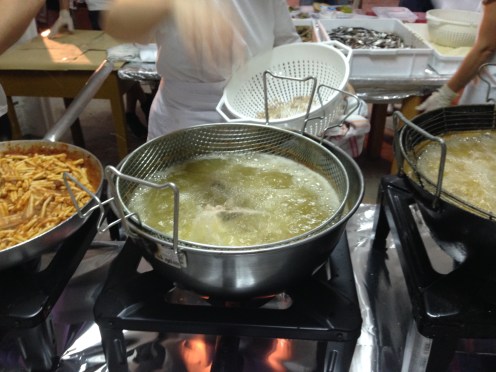
The fish being served, Pesce Azzurro, is not a scientific term, but a commercial one which includes a number of fish that share some common characteristics. In this specific case, the fish utilized for the Pesce Azzurro Festival were anchovies and sardines. The festival took place in a small section of the town. As I asked one of the cooks for some details, I was told that both anchovies and sardines were being utilized. The sardines and anchovies were cleaned and after being tossed in semola flour they were deep fried.
Clean freshly caught sardines and anchovies

Sardines and anchovies tossed in semola flour
Frying the fish
 Fried sardines and anchovies

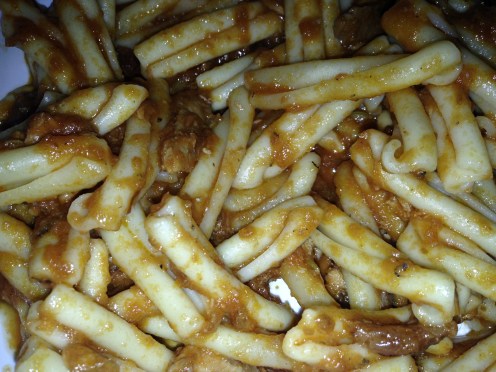
Besides the fried sardines and anchovies there was a pasta dish. The pasta dish, seen below, was Pasta alle Sarde, Pasta with Sardines. The ingredients utilized for this dish were sardines, tomatoes, wild fennel and pine nuts. Pasta with sardines is a popular dish in Sicily and although the original recipe is from Palermo, I have experienced different twists to the recipe in different locations around the island. In this dish prepared in Marzamemi, more tomatoes were utilized than I had ever had before.
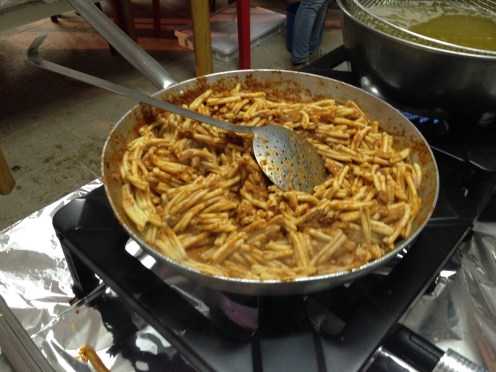
Pasta alle Sarde – Pasta with Sardines
Following are some images from Marzamemi.
Piazza Regina Margherita- Church and old fishermen houses turned into restaurants and cafes’

Popular photo of one view of Piazza Regina Margherita
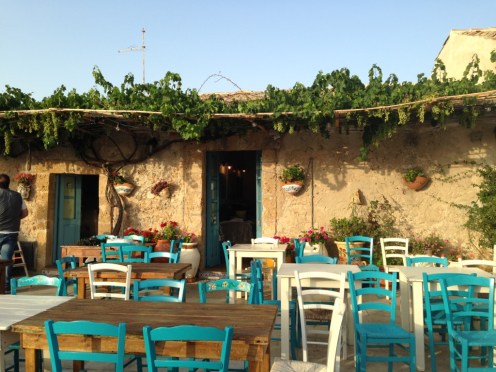
Along the coast heading to the village center

Quiet spot along the coast next to Marzamemi village center

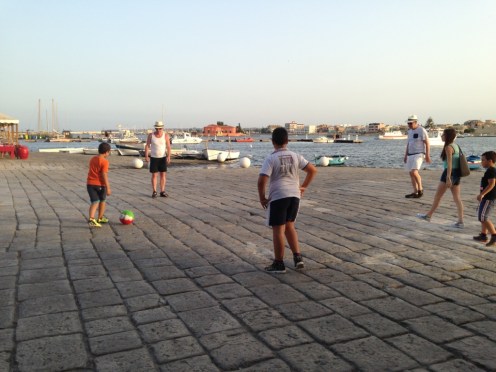
In closing, a spontaneous soccer match played by local children and German visitors on the waterfront in Marzamemi
One of my favorite pastimes while growing up on a coastal town, Catania, was to sit on the coast, on a summer night, and watch in fascination the lighted fishing boats, le lampare, dotting the deep dark sea as sparkling stars. Lampare is the name of the fishing boats with lights and they were named after the name of the lights themselves, lampare. In the past , the lampare were gas lights and attached to the boats their purpose was to illuminate the surface of the sea to attract the fish to the surface.
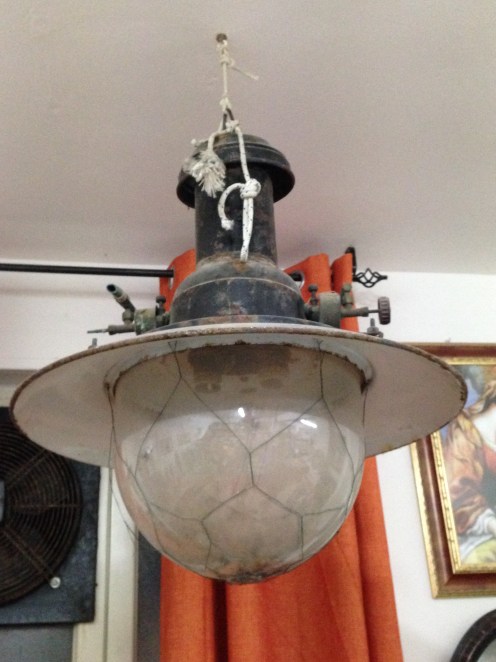
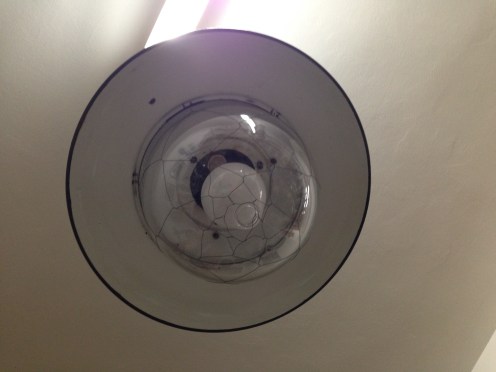
Lampare have been part of the fishing tradition in Sicily for many many years. So when I recently walked into a shop on a coastal town of Sicily, Marzamemi, I was pleasantly surprised to see the original old gas light, lampara, up close for the very first time. Strangely enough, I had been listening to one of my favorite songs, Caruso, by Lucio Dalla, which mentions the lampare, and here I was now, actually running into an authentic, old style, fishing gas light, lampara. The owner of the store, Paolo Mallia, proceeded to explain and point out that the lampare he was selling were the original gas lit ones. Nowadays, lampare utilize LED. Below are two photos of the lampare I saw in Mallia’s shop.
Lampara a gas – lateral view
Lampara seen from below
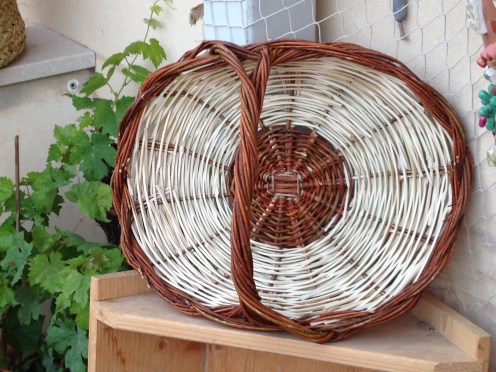
As I explored the traditional Sicilian items sold in this used/antiques shop, Il Rigattiere, I loved the basket below. This basket is a traditional fish basket and is made of willow and sand reeds.
Some old amphoras in terracotta

Traditional Sicilian terracotta bowls and molds

Polpari – Terracotta amphoras to catch octopus/i –

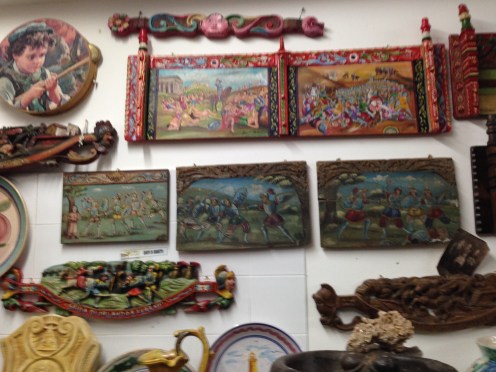
Finally, some Sicilian Cart parts with their colorful representations of historical events and epics
Whenever I travel through Sicily, I am fascinated by the architectural beauty as well as the natural one. I enjoy climbing up to high areas and looking down. Rooftops fascinate me. Following are some of the pictures I have taken of rooftops in Sicily, and one in Stromboli .
Rooftops and Cupola of Cathedral in Ragusa Ibla.
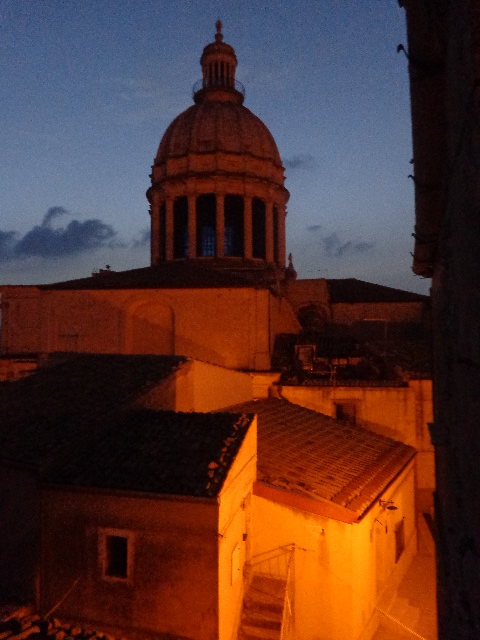
Ragusa Ibla rooftops.
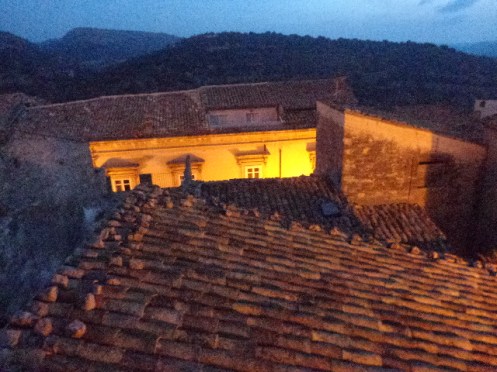
Scicli as seen from above on SP 42.

On these rooftops in Scicli, picture taken from the hill upon which Chiesa San Matteo is perched, I was fascinated by the tiled bench.

Rooftops in Motta S. Anastasia close to Catania

Caltagirone – I love this town!
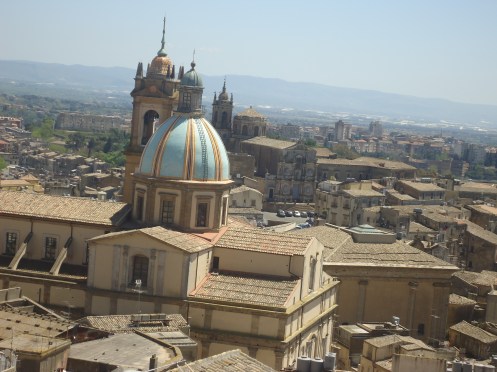
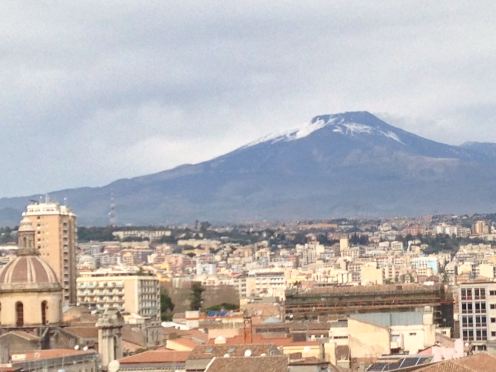
Rooftops in Catania with Etna in the backdrop.

Rooftops in Catania as seen from the terrace of the Saint Agatha Abbey. Etna in the backdrop.
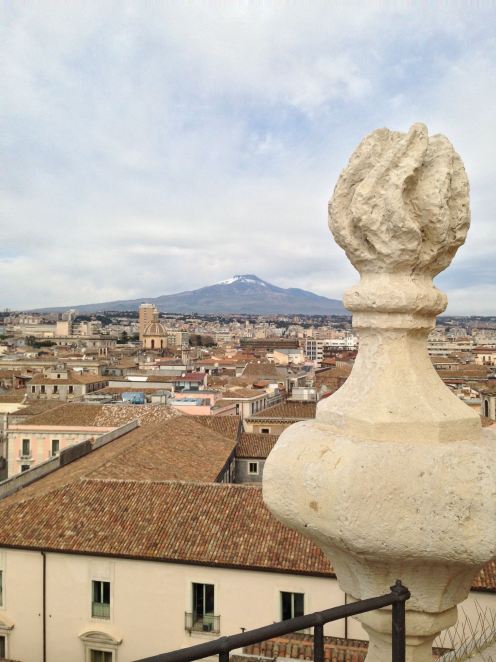
View from the Saint Agatha Abbey. To the left, “il grattacielo”, “skyscraper”, in Catania.
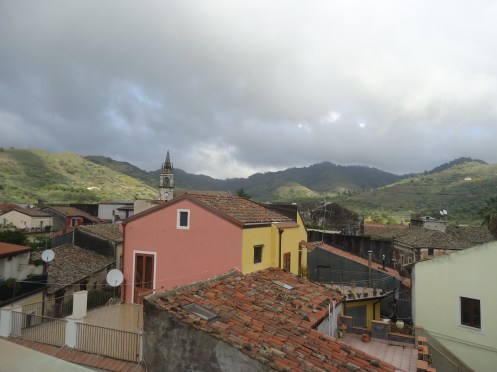
Rooftops in Linguaglossa
My favorite colors are seen in this picture taken in Stromboli, off the coast of Sicily!!!!

Lampedusa!!! An island off the coast of Sicily offers its visitors stunning landscapes!
One of my rules in blogging is to publish only pictures I have taken personally, but today, I am braking my rule!
My special childhood friend, Maria, is in Lampedusa as I write, celebrating her 60th birthday! She just sent me these photos to share the gorgeous locations she is visiting. As I am not currently in Sicily, these images bring back memories of this location which I visited many years ago!
I told Maria I would share these photos on my blog, so we can all enjoy these beautiful images, taken today, May 24, 2016, on the Island of Lampedusa, at the beach called Isola dei Conigli.


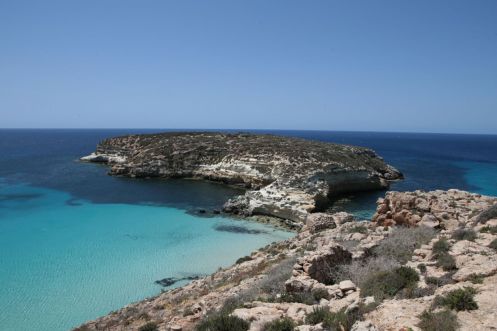
By the way, Isola dei Conigli Beach won 1st Prize for the Traveler’s Choice – The Best Beaches in the World – 2013 as seen in the TripAdvisor Poster below! I actually remember reading about that award in 2013!!!!!!

During a stroll through the town of Sciacca, I stopped at the shop of a local artist, Michele Bono, and enjoyed a lively conversation with the artist. Michele Bono expresses his artistic talent utilizing various arts forms, including fiberglass, paintings and sculptures. When I first entered his shop, what caught my attention were some heads made of fiberglass. Michael and I talked about these pieces and he mentioned how much he enjoyed studying and exploring pop art from the USA which also utilized fiberglass .
Fiberglass Head

When I looked at the following painting, representing a volcano, Michele told me that he was inspired by a natural event which took place off the coast of his hometown, Sciacca. At the beginning of the nineteenth century, an island appeared off the coast of Sciacca, Isola Ferdinandea, Ferdinandea Island. A few weeks after the island appeared, the island disappeared under water. It lies four kilometers under the water’s surface and gasses flow out of said island. It is of volcanic origin. This underwater crater is part of a larger crater which lies below the water along the coastline between the towns of Sciacca and Eraclea Minoa.

Piglets wallowing around in clean water

Sea has a great influence on the artist; the lamps below represent sea sponges.
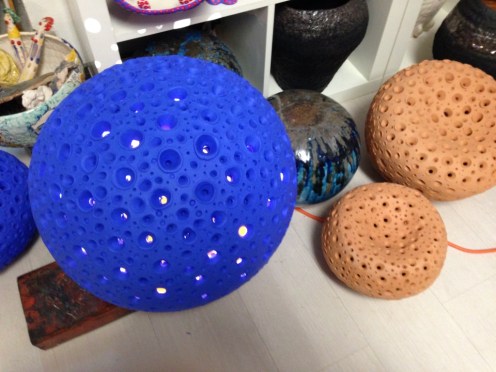
Batpanz – Terracotta policroma –
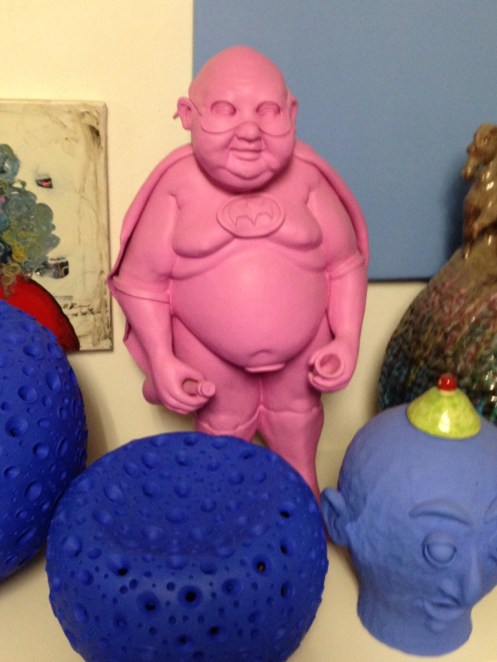
Michele explained his interpretation of the statue below made of terra-cotta . This representation is an anti-hero. This antihero doesn’t have lean muscles but a large abdomen. This artwork touches on a very sad topic. So many refugees have been fleeing to Sicily over the last few years. So many clandestine children have arrived on the shores of Sicily longing for a better life. As Michele stated, they come with dreams and end up in a bad situation, many times having to beg on the streets. Consequently, this antihero has not been able to save those children!!!
This terracotta head with the prickly pear plants on top of it is a different interpretation of traditional Sicilian terracotta heads.

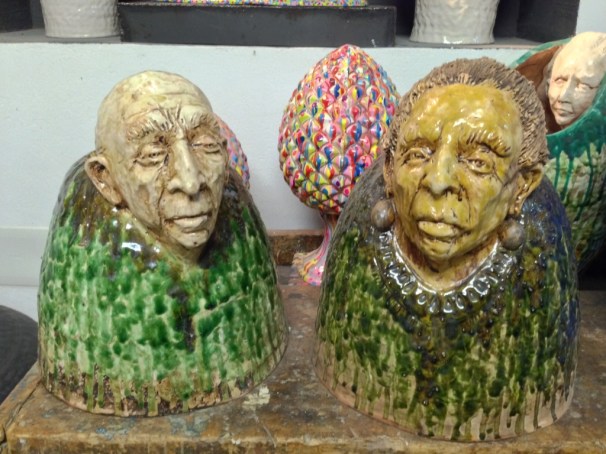
The following terra-cotta pieces represent two older Sicilians whose faces are a testimonial to their hard work in life!
Following is a Nativity scene. The capes are empty because this element represents the spirituality of the scene. Both in images and in sculptures on the topic of the Nativity, what we have always seen has been the result of what was handed down to us. However, if one has Faith, it is beyond the images that have been handed down. Consequently, it is the Spiritual element which we adore. The empty capes represent the spiritual element.

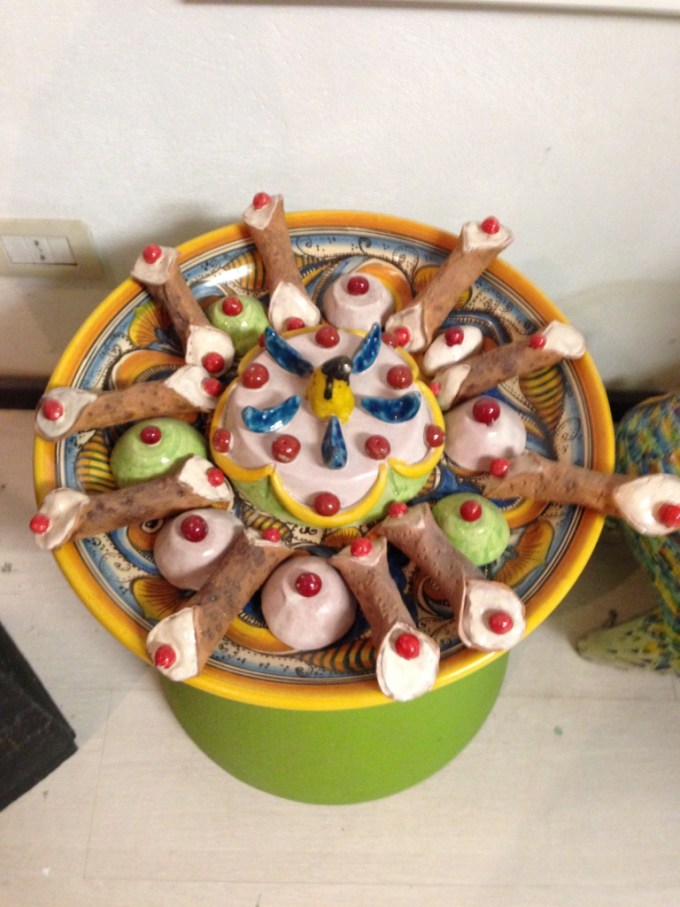
Ending on a sweet note, a representation in ceramic of two typical Sicilian deserts: Cannoli and Cassata!!!
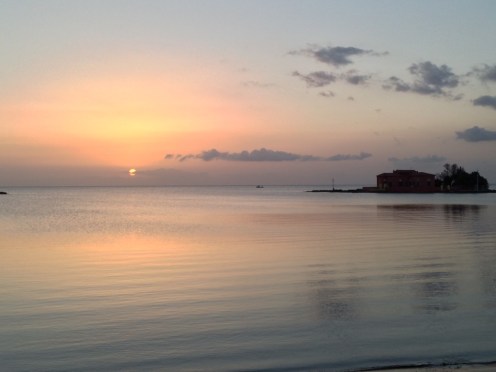
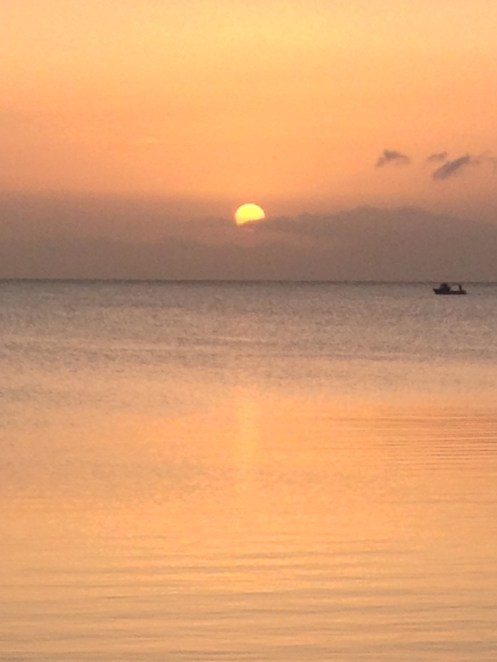
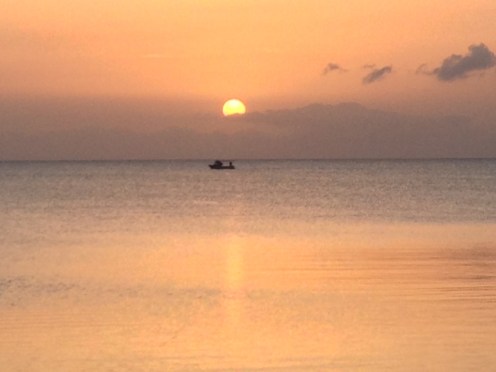
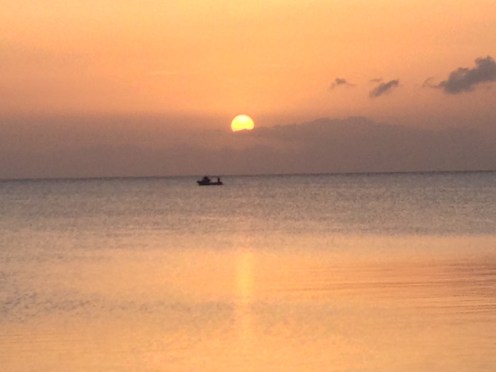
Marzamemi, a seaside town on the South-Eastern coast of Sicily, a few kilometers from Portopalo, at the southernmost tip of the island, is an old fishing town.
For many years, Marzamemi has gained popularity and is inundated by visitors during the Summer months.
I prefer the quiet atmosphere of the off-season, as in February. At this specific sunrise on February 25th, the only people on the streets were I and the street sweeper!



A lIvely, captivating, colorful and enchanting Carnevale in Sicily takes place each year in the town of Sciacca, a Medieval town which lies on the Southern Coast of Sicily, in the municipality of Agrigento. For days, the streets of the town come alive with music which snakes its way through each corner of the streets and alleys. The natural hues of the light stone Medieval buildings become the backdrop to the intensely rich colors of floats, costumes and masks.
Port of Sciacca

The Carnevale of Sciacca celebrated its one hundredth year anniversary in the year 2000. The mascot of this Carnevale is the character named Peppe ‘Nappa.
At the opening of the Carnevale in Sciacca, Peppe ‘Nappa arrives from the sea and is given the symbolic key to the town, thus announcing the beginning of the festivities. For several days, during the Carnevale, Peppe ‘Nappa’s float will be in the lead followed by all the allegorical floats that are participating in that year’s Carnevale.
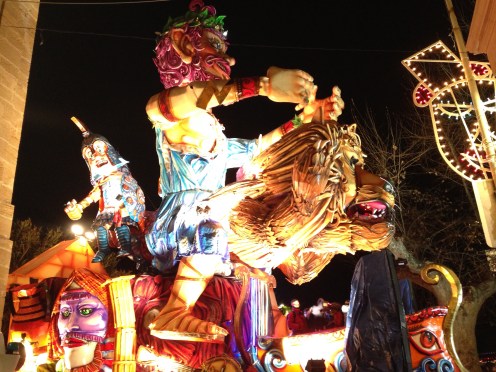
Each float is built by an association and the work is carried out by many artists, artisans and technicians, to name a few. Furthermore, each float has its own theme. For each theme, besides the float, there is a song, a musical performance and a short play all that support the theme of the float. The songs and dances are performed while the floats travel through town in the parade, and when each float stops for its turn at the main stage located in Piazza Scandaliato, the performers belonging to each specific float, have a chance to carry out their shows on the large stage and these involve singing, dancing and reciting.
Following are the names of the floats that participated in the Carnevale of Sciacca 2016:
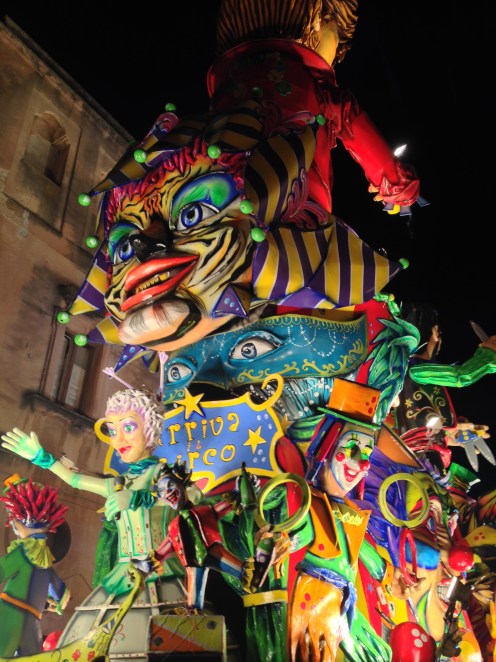
PEPPE ‘NAPPA, EXPORTIAMO, NON VOGLIO SOLO LA LUNA, ARRIVA IL CIRCO, LU DIAVULU E L’ACQUASANTA AND STA ZORBA…CHE DEI.
Following are some images from Carnevale di Sciacca 2016
PEPPE ‘NAPPA HOLDING THE SYMBOLIC KEY TO THE TOWN IN HIS RIGHT HAND

EXPORTIAMO – WE EXPORT
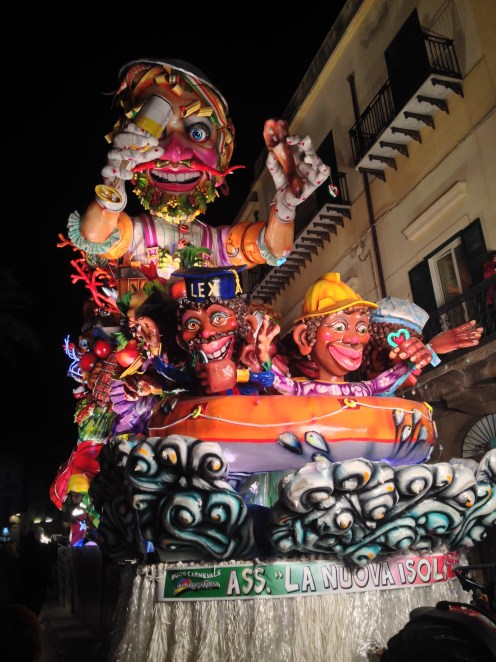
NON VOGLIO SOLO LA LUNA – I WANT MORE THAN THE MOON

ARRIVA IL CIRCO – THE CIRCUS IS IN TOWN
BACK OF FLOAT
LU DIAVULU E L’ACQUASANTA – THE DEVIL AND THE HOLY WATER

STA ZORBA…CHE DEI – THIS ZORBA DANCE…WHAT GODS
LATERAL VIEW
THE STAGE IN PIAZZA SCANDALIATO WHERE PERFORMANCES TAKE PLACE

Dancers for Arriva il Circo

Dancers for Non Voglio Solo La Luna

I had a chance to speak to several local people during this Carnevale, walking through town and enjoying the festivities. It was interesting to glean different points of view. There were those who recounted the Carnevale of the past, in this town, when there were twice the number of floats participating. Some mentioned that today’s smaller number of floats were representative of the current times of crisis, when times are hard. Yet, others stated that the reason those planning the event have chosen to have fewer floats is indeed to allow a better flowing of the events and the crowds. Those stating the second explanation, mentioned that in evaluating the results of each Carnevale after each event, those who had planned the event could state that there were fewer incidents occurring in the least crowded Carnevali. I must say that I personally was surprised at the ease in following the floats around town, of how there were no barriers and there was a good flow of people that could walk around and go from one float to another.
However, there is one story that has stuck in my mind as it was told to me by one of the local people I talked to during the Carnevale. This person mentioned some of the old traditions that have gone lost, as many traditions do over time. In his retelling the traditions of the past, he mentioned how in the old days, the local families would participate in what was called “I Sabatini”, Sabato being Saturday. For two months, before Carnevale, families which were involved in the building of the floats, would meet on Saturday night. They would all meet in a large garage and enjoy music, dancing and food. Each family would bring enough food to share with others and late at night, after the dancing, they would all eat together, sharing the food they had brought with one another. This was called “schiticchia.” This group would then choose a theme to adopt for Carnevale and on the occasion of Carnevale they would all go out as a group, all dressed alike, following the same theme. I mentioned that I saw a little of this while enjoying Carnevale Sciacca 2016 as there were small groups of participants dressed alike, but certainly not groups as large as the ones mentioned in this retelling of the past. One more element that has changed by the recollections of those that I spoke to regarding carnival traditions and changes is the fact that in the past there were small floats also participating in the Carnevale. The person recounting this memory stated that it was thanks to the small floats that people would gain the practice and experience necessary to then move on to creating the larger floats.
All this confirms that each person has their own set of memories and preferences as in many aspects of life! To each their own beliefs are important and this is certainly worth respecting.
Carnevale in Sciacca is full of enjoyable events and the culminating event is a performance by representatives of all of the groups that have participated and returning the key of the town to the Mayor of Sciacca. Finally, the burning of Beppe ‘Nappa officially concludes the Carnevale.
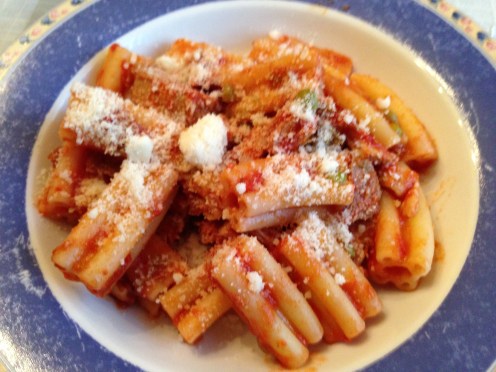
In closing, I will share two of the culinary traditions of Carnevale in Sicily. The first I will mention is the pasta ai cincu purtusi, pasta with five holes. Tradition states it is eaten on Fat Thursday and the dish below is the one I ate thanks to my friend Rosi who cooked it for me soon after my return to Sicily last week!
The second culinary tradition I shall mention is one of the desserts enjoyed at Carnevale, le Chiacchere. Chiacchere is the name of this dessert in Sicily, as they are enjoyed in other regions of Italy, too, but have different names in different regions of Italy. The chiacchere pictured below are the ones with a little chocolate!

All in all, Carnevale in Sciacca 2016 was certainly worth all the miles I had to travel to attend!!!!!!!!
La Festa di Sant’Agata, the celebration of Sant’Agata, Patron Saint of Catania, takes place each year from February 3rd to the 5th, in the City of Catania, Sicily. The Statue of The Saint is carried around the city, following specific traditional routes, which are the same year after year. The man pulled vehicle, called ‘a vara” in Sicilian dialect, “fercolo” in Italian, carries the Statue of Sant’Agata throughout the city for three days and one long night. The crowds gather around the “fercolo” and many devotees wearing the traditional white tunic, “u saccu di Sant’Agata”, are both “i portatori”, the pullers, as well as followers. The thick ropes that pull the “fercolo”are just over 100 meters long.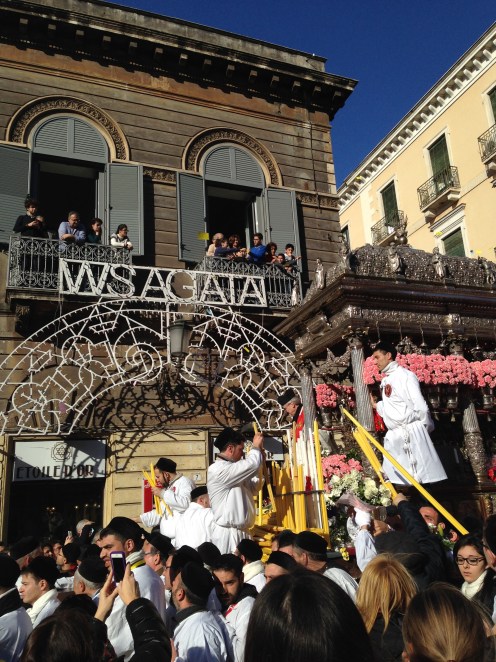
Picture below portrays “i portatori” pulling the “fercolo” in Via Umberto on the afternoon of the 4th of February

People gather on rooftops and balconies to view the procession
Three young devotees wearing “u saccu”
Enormous candles are made for the occasion

Piazza Duomo – The Cathedral in backdrop with the symbol of Catania, the Elephant, “u liotru”. In this picture, one can see the “Cerei”, “i cannaroli” in Sicilian, gathered around. The cerei will tour the city for days on the occasion. Each “cereo” is made by an association and the people of that association will carry the cereo on their shoulders for long, long hours.

“i portatori” pulling the “fercolo”
Two Carabinieri guarding the Statue of Sant’agata during Mass in the Cathedral

Sant’Agata was born in the III Century A.C. and lived in Catania. At that time, the Romans ruled Catania and Procunsul Quinziano had been sent to enforce the Edict of Decius that dictated Christians renounce their Faith publicly or suffer severe consequences. Agata was a young Christian girl. After the pressures of renouncing her Faith, she refused and also resisted to the personal advances by Quinziano, who took a personal interest in the girl as stated in many sources on the topic. Consequently, Agata was tortured and died in her prison cell. Nowadays, many people make a vow to the Saint and promise to wear a white tunic during the celebrations of her Feast each year. The tunic, called “u saccu” is worn by the devotees, both female as well as male and of all ages.
Caltagirone is renown for its ceramics and the many artisans that have created beautiful ceramic works of art over the centuries. Walking through the town at any time of the year one can enjoy the display of a rich variety of ceramic pieces created in the traditional patterns and colors that distinguish which period of time the piece represents. In this blog, there are two previous posts on Caltagirone written in May 2012 and October 2911.
In December, the town puts on a show of many presepi, nativity scenes, and there are presepe itineraries to follow which lead on a walk around the town visiting the many presepi on display. While the traditional presepe is made of terracotta, over the years, artisans have elaborated on their creativity in their choice of materials. Following are a few examples of presepi on display in Caltagirone during the month of December.
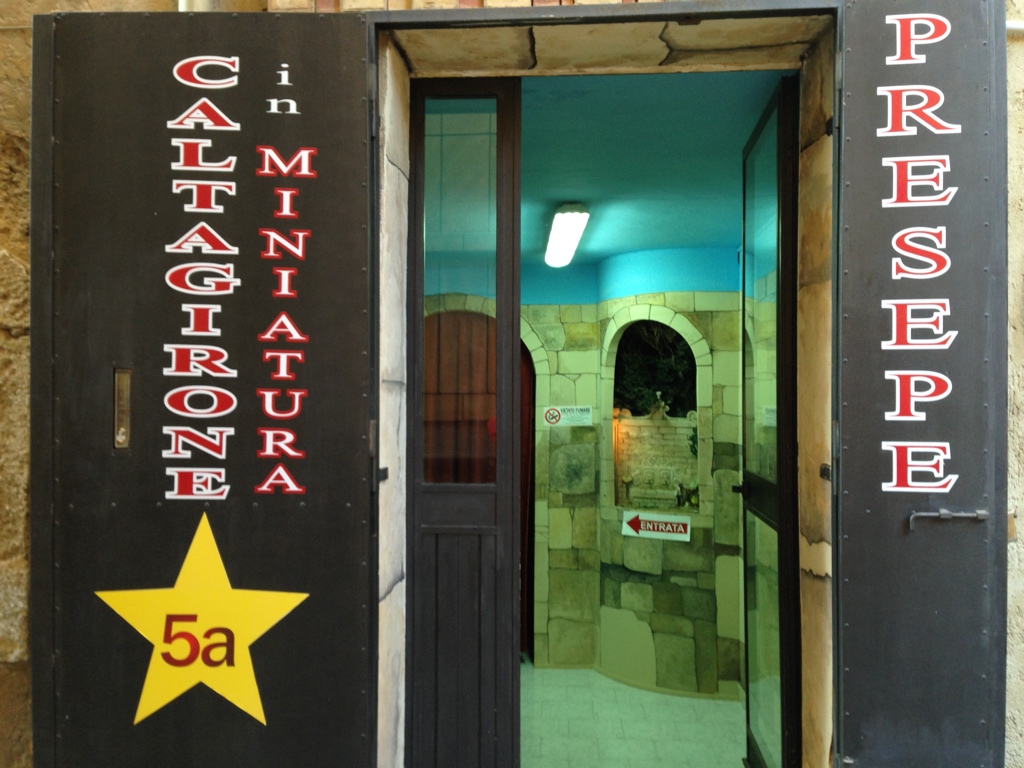
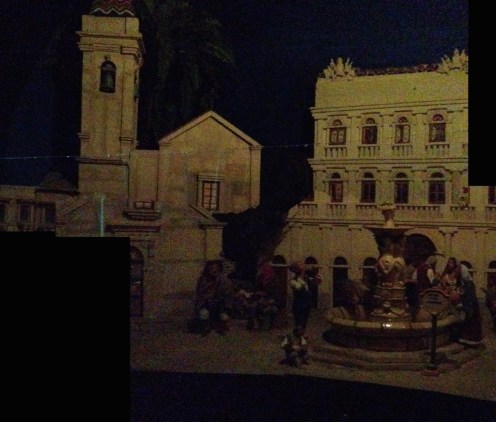
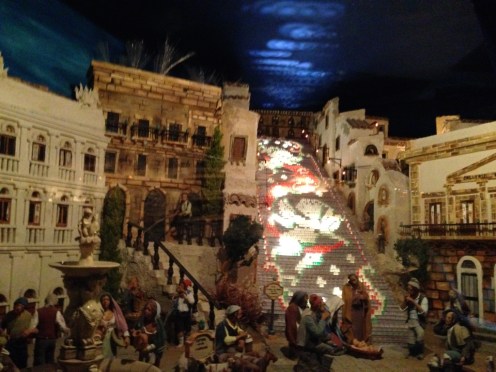
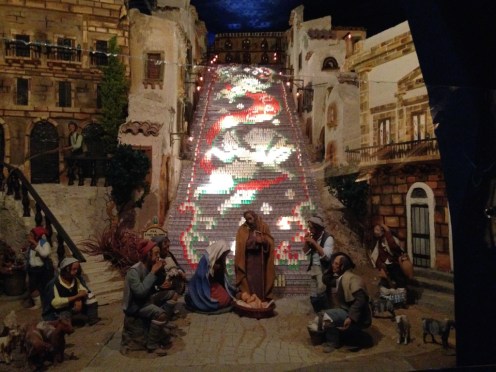
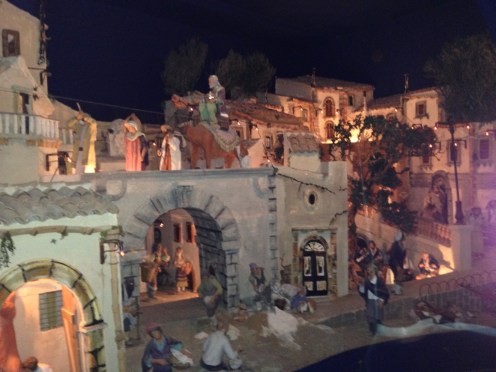
The following presepe is a miniature version of the town of Caltagirone itself.




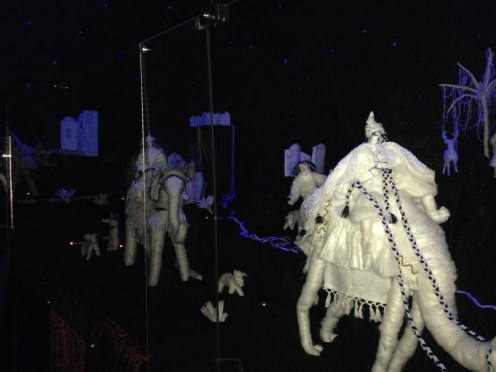
The following presepe is made of cotton wool
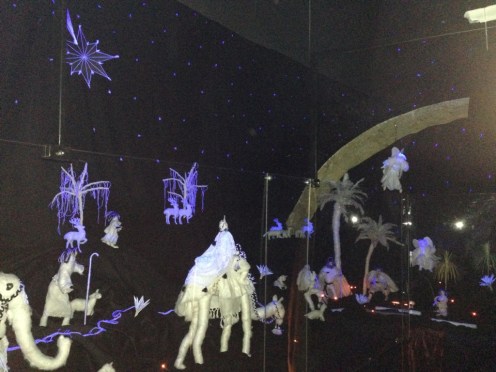


Presepe made of aluminum mesh
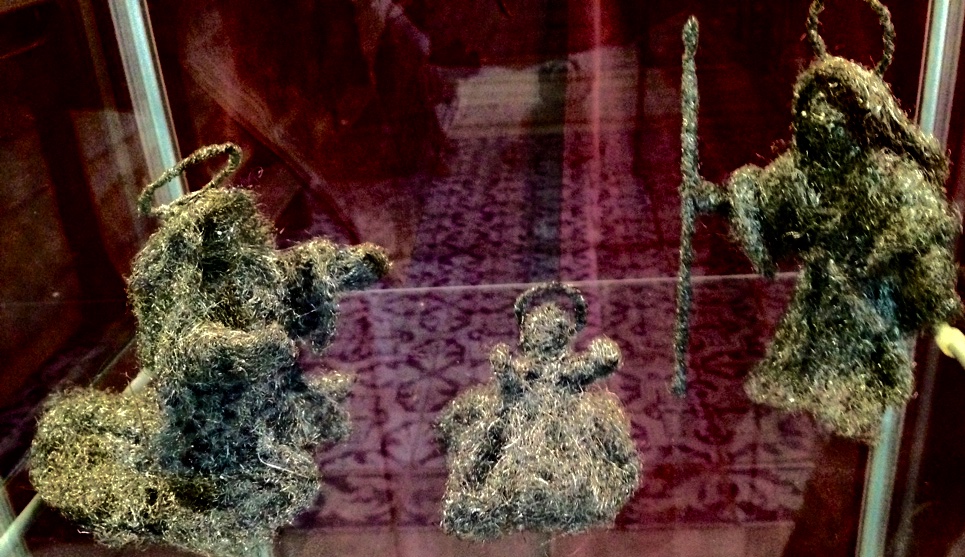
Presepe made of aluminum foil

Presepe made of packing tape

Presepe made of metallic wire

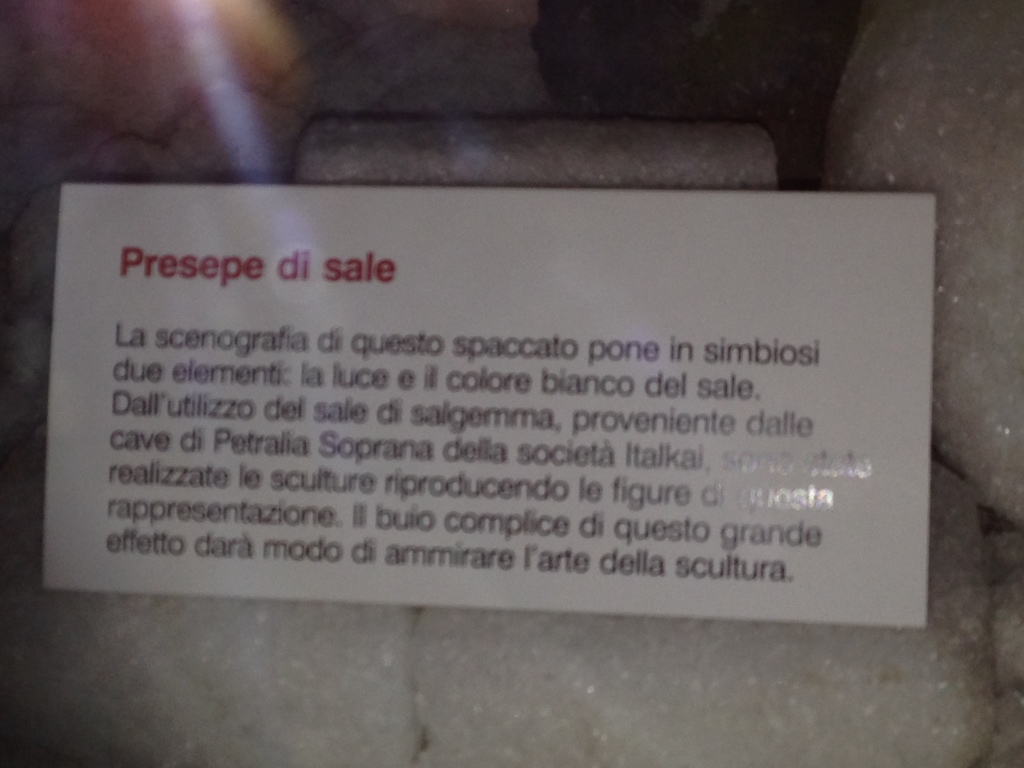
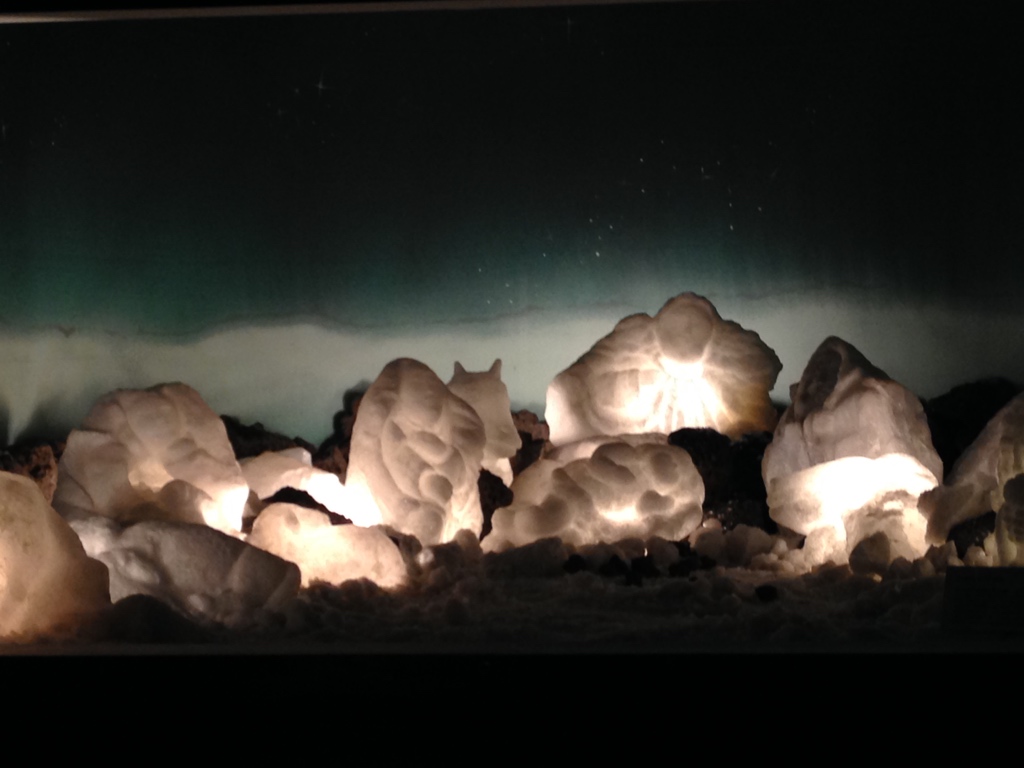
Presepe di sale – Nativity made of salt –
These are just a few examples of the MANY Presepi on display all over Caltagirone!!!!!
 Sicily & MORE Explored by Rosanna